Beyond the Bolt: Why Your Factory Lug Nuts Can Ruin Aftermarket Wheels
Reusing OEM hardware on aftermarket wheels is a common mistake that leads to vibration and safety risks. Learn how to match seat types and avoid the 'swollen lug' trap.
Shop accessories
Browse all accessories
The Hidden Danger of Hardware Reuse
You just invested in a fresh set of alloys from RimRevival, but before you reach for your factory lug nuts, stop. One of the most frequent mistakes enthusiasts make is assuming that if the thread pitch matches, the hardware is safe to use. In reality, using OEM (Original Equipment Manufacturer) lug nuts on aftermarket wheels is a leading cause of wheel vibration, damaged mounting surfaces, and even catastrophic wheel loss.
1. The Seat Type Mismatch
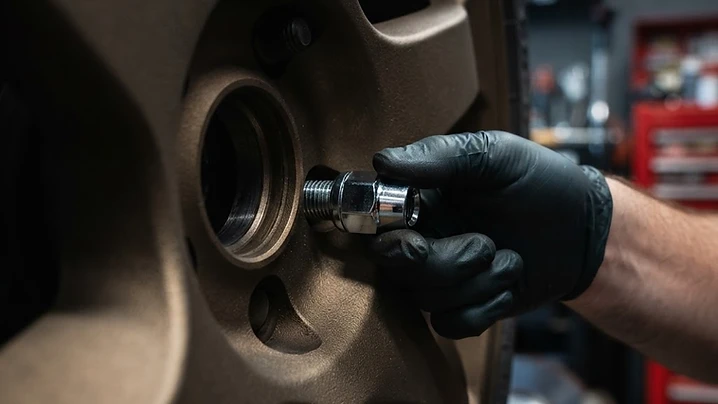
The most critical factor in wheel security is the "seat"—the area where the lug nut meets the wheel. Most aftermarket wheels are designed with a 60-degree conical (tapered) seat. However, many major manufacturers use different standards:
- Ball Seats: Common on Honda, Acura, and Volkswagen/Audi vehicles. These are rounded like a bowl.
- Flat/Mag Seats: Often found on Toyota, Lexus, and older domestic trucks. These use a flat washer and a cylindrical shank that slides into the wheel [22, 23].
If you put a ball-seat lug nut into a conical-seat aftermarket wheel, you create a tiny point of contact rather than a flush surface. This concentrated stress can cause the lug nut to back out or the wheel's mounting hole to crack [23].
2. The "Swollen Lug" Nightmare
Many modern vehicles (particularly from Ford, Chrysler, and Jeep) come with two-piece "capped" lug nuts. These consist of a steel core with a decorative chrome or tin cover pressed over the top [22]. Over time, moisture gets trapped between the layers, causing the cap to swell.
Not only do these become impossible to remove with a standard socket, but they are often too bulky to fit into the narrow lug holes of aftermarket wheels. When shopping for new wheels, always opt for solid, one-piece forged steel lug nuts to ensure long-term durability and ease of service [22].
3. Clearance and Spline Drives
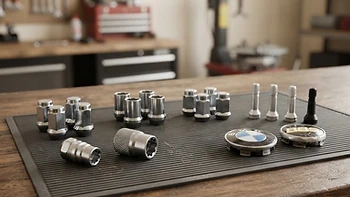
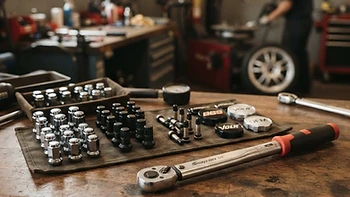
Aftermarket wheels often feature "tuner" styles with very narrow lug nut holes. A standard 19mm or 21mm hex socket simply won't fit inside the hole without scratching the finish. In these cases, you need Spline Drive lug nuts. These require a special thin-walled tool that provides better torque distribution and acts as a mild theft deterrent [17].
Buyer’s Hardware Checklist
Before completing your order, verify these three specifications:
- Thread Pitch: Ensure it matches your vehicle (e.g., M12x1.5, M14x1.5, or 1/2-20) [15].
- Seat Profile: Match the hardware to the wheel, not the car. Most aftermarket wheels require a 60-degree conical seat [23].
- Outer Diameter: If your new wheels have narrow holes, purchase a spline-drive kit with a matching key.
Proper hardware is the only thing keeping your wheels attached to your hubs. Don't let a $50 set of reused bolts compromise a $1,500 set of wheels.
Find wheels for your car
Pick your make and model — we'll show you every wheel that fits your bolt pattern.
Get notified when new wheels are listed
New listings drop daily. Be the first to know when wheels for your car hit the marketplace. No spam, unsubscribe anytime.