Tire Pressure Gauge Types: Digital vs Analog vs Dial
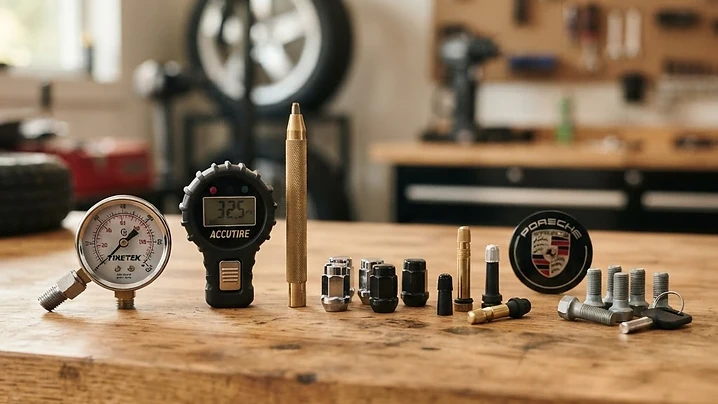
A tire pressure gauge is the most important tool you own. Here is how the three types compare on accuracy, reliability, and use case.
Shop accessories
Browse all accessories
Tire Pressure Gauge Types: Digital vs Analog vs Dial
A tire pressure gauge is the most important tool a car owner can own — and the most commonly cheap. The type you use affects accuracy, and accuracy is what keeps your tires safe and long-lasting.
The Three Types
Digital (Electronic)
A pressure sensor with a digital display. Typically accurate to +/- 1 PSI. Displays to one decimal place.
Analog (Stick / Pencil)
A calibrated piston that pushes a stick out of the barrel. The simplest and most common gauge. Accuracy varies — quality matters.
Dial (Bourdon Tube)
A curved tube that straightens under pressure, moving a needle on a dial face. The most mechanical and the most traditional. Preferred by professionals.
Accuracy Comparison
Digital
- Best accuracy when battery is fresh — typically +/-0.5 PSI
- Accuracy degrades as the battery drains
- Best for: Low pressures (under 10 PSI, like motorcycles and bicycles) where the decimal matters
- Worst for: When the battery is dead — the gauge is useless
Analog (Stick)
- Good accuracy from quality brands (Milton, Accutire)
- Poor accuracy from cheap brands — some are off by 3+ PSI
- No batteries — always ready
- Best for: Keep-in-the-car emergency use
- Worst for: Precise tuning
Dial
- Excellent accuracy — typically +/-1 PSI across the range
- No batteries — always ready
- Sensitive to drops — the Bourdon tube can be knocked out of calibration
- Best for: Home garage and professional use
- Worst for: Rough handling — the most fragile of the three
What to Look For
Range
Choose a gauge with a range that puts your normal pressure in the middle of the scale. A 0-60 PSI gauge for a 35 PSI tire is ideal. A 0-150 PSI truck gauge for a 35 PSI tire puts the reading in the bottom quarter of the scale — where accuracy is worst.
Resolution
For car use, 0.5 PSI resolution is enough. More resolution than that is not meaningful — tire pressure changes by 1 PSI per 10 degrees of temperature, so anything below 0.5 PSI is noise.
Calibration
Dial gauges can be calibrated and should be checked annually against a master gauge. Digital gauges cannot be calibrated — replace them when accuracy drifts. Analog stick gauges are disposable — replace when they feel inconsistent.
The Bleeder Valve
A good gauge has a bleeder valve — a small button that releases pressure so you can bleed down an overfilled tire without removing the gauge. This is essential for getting the pressure exactly right.
The Chalk Test
The best way to verify your gauge is to check it against another. Two gauges reading the same tire within 1 PSI of each other are both likely accurate. Two gauges reading 3+ PSI apart — one is wrong.
Recommendation
- Daily driver: A quality digital gauge ($15-25) for the glovebox, backed by a dial gauge ($20-30) at home.
- Performance/track: A dial gauge with 0.5 PSI resolution for consistent setup.
- Emergency: A stick gauge — it has no batteries and always works.
The gauge matters more than the tire choice. A $10 tire at the right pressure outperforms a $200 tire at the wrong pressure.
Find wheels for your car
Pick your make and model — we'll show you every wheel that fits your bolt pattern.
Get notified when new wheels are listed
New listings drop daily. Be the first to know when wheels for your car hit the marketplace. No spam, unsubscribe anytime.