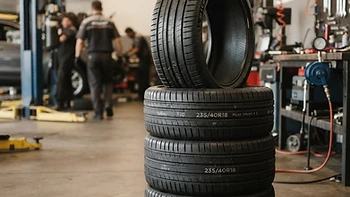
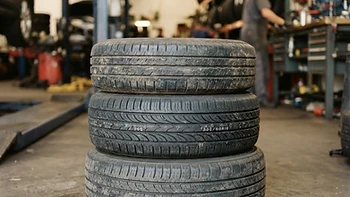
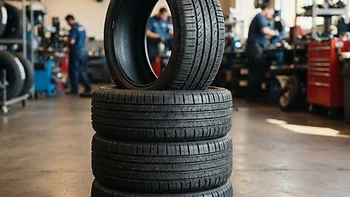
The Cold Truth: Why Your Tire Pressure Specs Only Matter Before You Drive
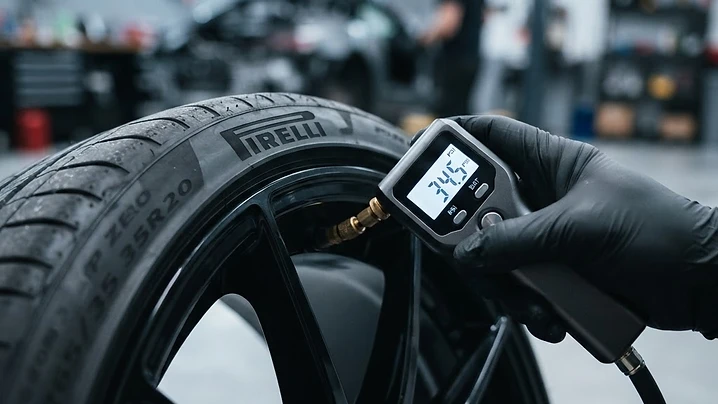
Stop chasing your tire pressure gauge after a highway run. Learn why 'cold' inflation is the only industry standard and how to manage pressure shifts caused by heat and weather.
Shop tires
Browse all available tires
Shop this article
Browse all tires
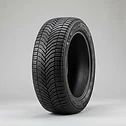
The Golden Rule of Tire Pressure
If you take one thing away from this guide, let it be this: Never bleed air from a hot tire.
In the shop, we see it all the time. A customer pulls in after a 30-minute highway drive, checks their pressure, sees it’s 5 PSI higher than the door placard, and lets air out to 'fix' it. By doing that, they’ve just created an underinflated tire. Once that rubber cools down overnight, they’ll be running significantly below the manufacturer’s recommended pressure, leading to increased rolling resistance, poor fuel economy, and potential sidewall failure.
Why 'Cold' is the Only Standard
Vehicle manufacturers and the Tire and Rim Association (TRA) base all recommended pressures on 'cold' inflation. This is defined as a tire that has been parked for at least three hours or driven less than one mile [9, 14, 20].
When you drive, the friction between the rubber and the road, combined with the constant flexing of the tire carcass, generates heat. According to the NHTSA and industry standards, it is perfectly normal for a tire’s pressure to increase by 3 to 6 PSI—or even more—after 30 minutes of highway driving [7, 14]. This is a feature of the design, not a defect. If you set your pressure while the tire is hot, you are essentially setting it to a 'moving' target that will vanish the moment you park.
The 10-Degree Rule
Beyond driving heat, ambient temperature plays a massive role. A reliable rule of thumb used by technicians is the 1 PSI per 10°F rule [7, 10, 14].
If you set your tires to 35 PSI on a 70°F afternoon, and the temperature drops to 30°F overnight, your tires will naturally read roughly 31 PSI the next morning [14]. The air didn't leak; the molecules simply slowed down and occupied less space [2, 10].
Pressure Dynamics Reference
| Condition | Pressure Change | Action Required | | :--- | :--- | :--- | | Driving (30+ mins) | +3 to +6 PSI | Do not adjust | | Temp Drop (10°F) | -1 PSI | Add air (cold) | | Temp Rise (10°F) | +1 PSI | Monitor (usually fine) |
Beyond Pressure: Tread and DOT Codes
While pressure is the most frequent maintenance task, keep an eye on the physical health of the tire.
- Tread Depth: Tires are legally bald at 2/32 of an inch [17]. Use a dedicated gauge; don't rely on the 'penny test.' For wet-weather safety, many shops recommend replacing tires once they hit 4/32.
- DOT Date Codes: Look for the 'DOT' stamp on the sidewall [19]. The last four digits tell you the week and year of manufacture (e.g., '1223' means the 12th week of 2023). Even if the tread looks new, rubber compounds degrade over time; most manufacturers suggest inspecting tires annually after five years and replacing them regardless of tread depth by year ten.
What to do next
- Buy a quality gauge: Digital or high-end analog gauges are far more accurate than the cheap 'pencil' style sticks found at gas stations [15].
- Check monthly: Tires naturally lose 1–1.5 PSI per month through permeation [7]. Make it a habit to check your cold pressure on the first of every month.
- Use the door placard: Ignore the 'Max PSI' listed on the tire sidewall—that is a structural limit, not a performance recommendation [4, 11]. Always use the sticker inside your driver’s door jamb [20].
- Adjust for seasons: When the seasons change, check your pressures during the first cold snap of autumn and the first warm week of spring to compensate for ambient temperature shifts [14].
Find wheels for your car
Pick your make and model — we'll show you every wheel that fits your bolt pattern.
Get notified when new wheels are listed
New listings drop daily. Be the first to know when wheels for your car hit the marketplace. No spam, unsubscribe anytime.