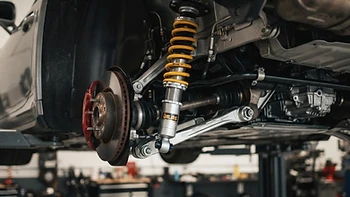
Sub-Zero Stance: Surviving Cold Soaks, Brittle Rubber, and Salt Seizure

When the mercury drops below 45°F, performance coilovers, low-profile tires, and lightweight alloy wheels face sudden physics penalties that can compromise your chassis.
Shop suspension
Browse sport suspension parts
Shop this article
Browse sport suspension
Crown Automotive Wheel Spacer Set (2), 5 on 5.5"
$178.5

Wheel Spacers 5x112 12mm 66.6mm Hub Centric fits Mercedes
$4.5

Original Gorilla Lock Set - Acorn Bulge - 3/4" Hex - 1/2"-20 Thread Size - Chrome Finish - Set of 5 (71481NB5)
$45

McGard 27226 Chrome Bolt Style Cone Seat Wheel Lock Set (M14 x 1.25)
$44.99
Every winter, performance shop bays across the Northeast, Upper Midwest, and mountain regions see the exact same casualties: seized aluminum coilover lock rings, cracked ultra-high performance (UHP) summer tires, and forged wheels oxidized white at the bead seats.
When a tuned car sits parked outside in freezing weather, it experiences a "cold soak"—a state where metal, atmospheric air, damper fluid, and elastomer compounds reach thermal equilibrium with sub-freezing ambient air. If your chassis runs track-oriented suspension and tight-tolerance hardware, cold weather is not merely an inconvenience; it completely alters your car's mechanical grip and structural durability.
The Physics of Cold-Soak Pressure Loss
According to data from the Tire Industry Association and Tire Rack, a tire loses approximately 1 PSI for every 10°F drop in ambient temperature. This relationship is dictated by Gay-Lussac’s Law: in a sealed volume, absolute pressure is directly proportional to absolute temperature.
Here is how that plays out in reality. If you calibrate your low-profile 255/35R19 track tires to an optimal cold pressure of 34 PSI inside a heated 65°F garage, and you park outside overnight in a 15°F freeze, that tire undergoes a 50°F cold soak. You will wake up to roughly 29 PSI before turning a wheel.
Under-inflation on low-profile sport tires creates severe liability:
- Wheel Bead Vulnerability: With a reduced air spring, driving over frost heaves and sharp winter potholes transfers force directly through the sidewall into the wheel lip, cracking forged alloys or bending cast barrels ($250 to $800+ in replacement costs per corner).
- TPMS Triggering: Under NHTSA Federal Motor Vehicle Safety Standard (FMVSS) No. 138, Tire Pressure Monitoring Systems must warn drivers when inflation drops 25% below the placard recommendation. A seasonal swing combined with normal monthly air permeation (roughly 1 PSI/month) will trip dash warnings without an actual puncture.
| Setting / Condition | Ambient Temp | Effective Pressure (Base 35 PSI at 70°F) | Primary Dynamic Risk | | :--- | :--- | :--- | :--- | | Baseline Heated Garage | 70°F (21°C) | 35.0 PSI | Baseline reference spec | | Late Autumn Morning | 45°F (7°C) | 32.5 PSI | Reduced steering crispness | | Moderate Freeze | 25°F (-4°C) | 30.5 PSI | Rim protection degraded, TPMS borderline | | Extreme Deep Freeze | 5°F (-15°C) | 28.5 PSI | High blowout risk on frost heaves, bead unseating |
The 45°F Rubber Transition: Glass, Not Elastic
Summer performance and 200-treadwear track tires rely on soft synthetic polymer matrices loaded with high concentrations of carbon black and resin. Their design target is optimum viscoelastic hysteresis at operating temperatures between 140°F and 200°F.
Once ambient temperatures drop below 45°F (7°C), these compounds encounter their Glass Transition Temperature ($T_g$). The molecular chains stiffen, shedding their elastic compliance and entering a brittle, glassy state.
Driving on summer tires below 45°F yields measurable hazards:
- Severe Compound Cracking: Flexing frozen, glassy tread blocks against tarmac causes mechanical stress fractures along the sipes and base grooves. Tire manufacturers (including Michelin and Continental) explicitly state that compound cracking sustained in sub-freezing storage or operation voids treadwear warranties.
- Braking Penalties: Testing by Consumer Reports and AAA has established that even on completely dry pavement, a summer compound below freezing can lengthen 60–0 mph stopping distances by 20 to 40 feet compared to a winter or cold-weather-optimized rubber compound.
If you run dedicated performance cars in winter states, transition to dedicated cold-weather rubber featuring high silica ratios and cold-resistant polymers (such as high-butadiene matrices) once daytime highs stabilize below 45°F.
Coilover Seizure and Road Slush Chemistry
Municipal road crews deploy millions of tons of sodium chloride, calcium chloride, and liquid magnesium chloride each season according to state DOTs. As explained by Walser Automotive Group and Subaru Concord, road salt sticks to metal, pulls moisture out of the air, and keeps surfaces wet longer, turning every unshielded undercarriage part into an active oxidation cell.
For lowered vehicles and aftermarket suspensions, salt spray introduces specialized mechanical failures:
- Galvanic Corrosion on Threaded Bodies: Most aftermarket coilovers combine anodized 6061-T6 aluminum spring perches on zinc-plated or steel shock bodies. When briny slush penetrates the threads, the aluminum acts as an anode and corrodes violently against the steel, permanently seizing the collar in place.
- Mono-Ball and Spherical Joint Binding: Exposed pillow-ball top mounts and spherical control arm bushings lack heavy-duty grease boots. Road salt erodes the PTFE liner, inducing harsh metal-to-metal clunks and early joint play.
- Damper Seal Failure: Salt crystal crust dries on exposed, lowered shock shafts. When the suspension compresses over winter bumps, these hard crystals slide past the dust wiper, scarring the polyurethane oil seal and causing damping fluid leaks.
What to Do Next
- Check Pressures After Cold-Soak: Always measure and top off tire pressures first thing in the morning with a calibrated digital gauge before driving. Never bleed pressure from a warm tire after highway commuting.
- Apply the 1 PSI per 10°F Rule: Anticipate major cold fronts. If the forecast predicts a drop from 50°F to 20°F, proactively add ~3 PSI to offset natural air contraction.
- Coat Your Coilover Threads: Wash salt out of the wheel wells weekly, thoroughly dry the suspension, and treat all exposed coilover threads with a non-sticky, water-displacing dry lubricant or dedicated marine corrosion inhibitor (such as Boeshield T-9 or ACF-50). Avoid standard grease, which traps road grit.
- Install Neoprene Coilover Sleeves: Wrap adjustable shock bodies in Velcro neoprene coilover covers before the first snowfall to mechanically shield the adjusters from chemical brine.
- Respect the 45°F Storage Rule: If storing your summer/track wheels in an unheated shed or garage, elevate them off bare concrete. Never move or mount a performance tire that has cold-soaked below 20°F until it has thawed indoors for at least 24 hours.
Find wheels for your car
Pick your make and model — we'll show you every wheel that fits your bolt pattern.
Get notified when new wheels are listed
New listings drop daily. Be the first to know when wheels for your car hit the marketplace. No spam, unsubscribe anytime.
Related listings
Browse sport suspensionCrown Automotive Wheel Spacer Set (2), 5 on 5.5"
$178.5
Wheel Spacers 5x112 12mm 66.6mm Hub Centric fits Mercedes
$4.5
Original Gorilla Lock Set - Acorn Bulge - 3/4" Hex - 1/2"-20 Thread Size - Chrome Finish - Set of 5 (71481NB5)
$45
McGard 27226 Chrome Bolt Style Cone Seat Wheel Lock Set (M14 x 1.25)
$44.99
Keep reading

Coilovers 101: What to Know Before You Drop Your Ride
6 min
Lowering Springs vs Coilovers: Which Is Right for You?
5 min
Bump Stops and Travel Limits: What Happens When the Suspension Bottoms
7 min