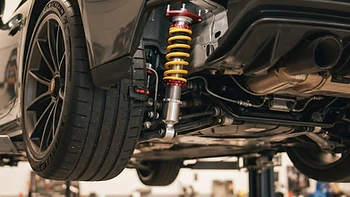
Bump Stops and Travel Limits: What Happens When the Suspension Bottoms

Bump stops are the most-overlooked part of a lowered build. Here's how they protect your shocks and why up-travel is the number that actually matters.
Shop suspension
Browse sport suspension parts
Shop this article
Browse sport suspension
Crown Automotive Wheel Spacer Set (2), 5 on 5.5"
$178.5

Wheel Spacers 5x112 12mm 66.6mm Hub Centric fits Mercedes
$4.5

Original Gorilla Lock Set - Acorn Bulge - 3/4" Hex - 1/2"-20 Thread Size - Chrome Finish - Set of 5 (71481NB5)
$45

McGard 27226 Chrome Bolt Style Cone Seat Wheel Lock Set (M14 x 1.25)
$44.99
Bump Stops and Travel Limits: What Happens When the Suspension Bottoms
Bump stops are the most overlooked part of a suspension build — and the part that quietly determines whether your expensive coilovers live a long, happy life or get destroyed in a season. Understanding them means understanding how your suspension behaves at full compression.
What a Bump Stop Actually Is
A bump stop is a piece of rubber (or urethane, or on quality coilovers, a micro-cellular foam donut on the shock shaft) that catches the suspension at the very end of its up-travel. It's the last thing between "the wheel is as high as it can go" and "the shock bottoms out internally and bends."
Without one, the shock piston slams the bottom of the body. That's a metal-on-metal hit that bends shafts, blows seals, and cracks mounts.
Why Lowering Changes Everything
When you drop a car on coilovers, you raise the threaded collar up the shock body. That eats into the available up-travel — the wheel has less room to rise before the chassis runs out of stroke. If you don't shorten the bump stop to match, the suspension rides on the stop permanently, which is both brutal and damaging.
That's why quality coilovers ship with trimmed or adjustable stops, and why the cheap ones that don't get you into trouble.
Up-Travel Is the Real Number
Every suspension spec sheet lists "total travel," but what matters on a lowered car is usable up-travel at ride height. The formula:
Usable up-travel = (shock stroke at full extension) − (sag at ride height)
If that number gets much below 2 inches, you're going to hit the bump stop on every pothole. Aim for at least 2.5–3 inches of up-travel for a streetable lowered car.
How to Set Up Bump Stops
- Measure full shock extension — put the car on jack stands, let the wheel hang, note the collar position.
- Measure ride height sag — set the car down at your target height, measure how far the spring compresses.
- Calculate the gap — that's your up-travel budget.
- Trim the stop so the remaining stroke is mostly travel, with just enough stop cushion to absorb the last 0.5 inch.
Skip this and you'll think your coilovers are harsh — when really you've just removed all the travel that was doing the work.
Find wheels for your car
Pick your make and model — we'll show you every wheel that fits your bolt pattern.
Get notified when new wheels are listed
New listings drop daily. Be the first to know when wheels for your car hit the marketplace. No spam, unsubscribe anytime.
Related listings
Browse sport suspensionCrown Automotive Wheel Spacer Set (2), 5 on 5.5"
$178.5
Wheel Spacers 5x112 12mm 66.6mm Hub Centric fits Mercedes
$4.5
Original Gorilla Lock Set - Acorn Bulge - 3/4" Hex - 1/2"-20 Thread Size - Chrome Finish - Set of 5 (71481NB5)
$45
McGard 27226 Chrome Bolt Style Cone Seat Wheel Lock Set (M14 x 1.25)
$44.99
Keep reading

How to Choose the Right Spring Rate for Your Build
5 min
Spring Rate, Wheel Rate, and Motion Ratio: The Number on the Spring Isn't the Whole Story
7 min
Coilovers 101: What to Know Before You Drop Your Ride
6 min