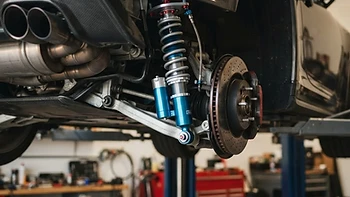
Spring Rate, Wheel Rate, and Motion Ratio: The Number on the Spring Isn't the Whole Story
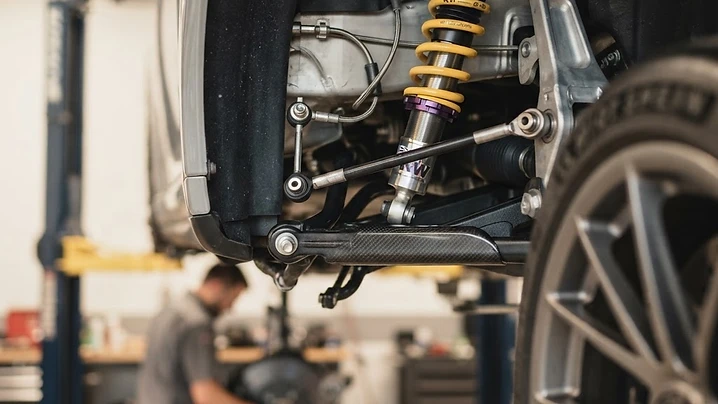
Two cars with the same 500 lb/in spring can feel nothing alike. Here's how motion ratio turns a spring rate into a wheel rate — and why the number on the spring isn't the whole story.
Shop suspension
Browse sport suspension parts
Shop this article
Browse sport suspension
Crown Automotive Wheel Spacer Set (2), 5 on 5.5"
$178.5

Wheel Spacers 5x112 12mm 66.6mm Hub Centric fits Mercedes
$4.5

Original Gorilla Lock Set - Acorn Bulge - 3/4" Hex - 1/2"-20 Thread Size - Chrome Finish - Set of 5 (71481NB5)
$45

McGard 27226 Chrome Bolt Style Cone Seat Wheel Lock Set (M14 x 1.25)
$44.99
Spring Rate, Wheel Rate, and Motion Ratio: Why the Number on the Spring Isn't the Whole Story
Two cars can run the same "500 lb/in" spring and feel completely different. The reason is the relationship between the spring and the wheel — and it's governed by a concept most builders never measure: the motion ratio.
The Three Numbers
- Spring rate is what's stamped on the spring — force per inch of spring compression.
- Wheel rate is the force per inch of wheel travel — what actually holds the car up.
- Motion ratio is the lever relationship between the two: how far the spring moves for every inch the wheel moves.
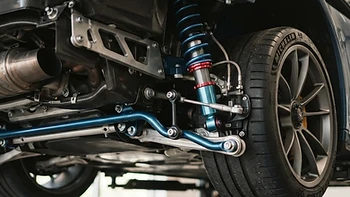
On a MacPherson strut, the wheel and spring move almost together — motion ratio is close to 1:1. On a double-wishbone or trailing-arm car, the spring sits partway along the control arm, so a 1-inch wheel movement might only compress the spring 0.6 inches. The motion ratio is roughly 0.6.
Why It Matters
Wheel rate is the spring rate multiplied by the motion ratio squared. That square is the part people miss.
Wheel rate = spring rate × (motion ratio)²
So a 500 lb/in spring with a 0.6 motion ratio gives a wheel rate of 500 × 0.36 = 180 lb/in. On a strut car (motion ratio ~1.0) that same 500 lb/in spring is a full 500 lb/in at the wheel.
That's why the "right" spring rate for a 911 and a Civic are wildly different even at similar weight — the geometry does the work.
What This Means for Your Build
- Don't copy spring rates across platforms. The number is meaningless without the motion ratio.
- A stiffer spring on a low-motion-ratio car has less effect than you think. Going from 500 to 700 on that 0.6 car only changes the wheel rate from 180 to 252.
- Heavier springs on strut cars bite harder at the wheel. That's why strut cars feel so much stiffer per lb/in of spring.
How to Find Your Motion Ratio
Measure how far the spring collar moves when you lift the wheel one inch. That ratio (spring travel ÷ wheel travel) is your motion ratio. Square it, multiply by the spring rate, and you've got the real wheel rate — the number that actually controls how the car rides and handles.
Find wheels for your car
Pick your make and model — we'll show you every wheel that fits your bolt pattern.
Get notified when new wheels are listed
New listings drop daily. Be the first to know when wheels for your car hit the marketplace. No spam, unsubscribe anytime.
Related listings
Browse sport suspensionCrown Automotive Wheel Spacer Set (2), 5 on 5.5"
$178.5
Wheel Spacers 5x112 12mm 66.6mm Hub Centric fits Mercedes
$4.5
Original Gorilla Lock Set - Acorn Bulge - 3/4" Hex - 1/2"-20 Thread Size - Chrome Finish - Set of 5 (71481NB5)
$45
McGard 27226 Chrome Bolt Style Cone Seat Wheel Lock Set (M14 x 1.25)
$44.99
Keep reading

How to Choose the Right Spring Rate for Your Build
5 min
Bump Stops and Travel Limits: What Happens When the Suspension Bottoms
7 min
Sway Bars and Chassis Bracing: Tightening Up the Handling
5 min