Torque Sequencing: The Star Pattern and Why It Is Non-Negotiable
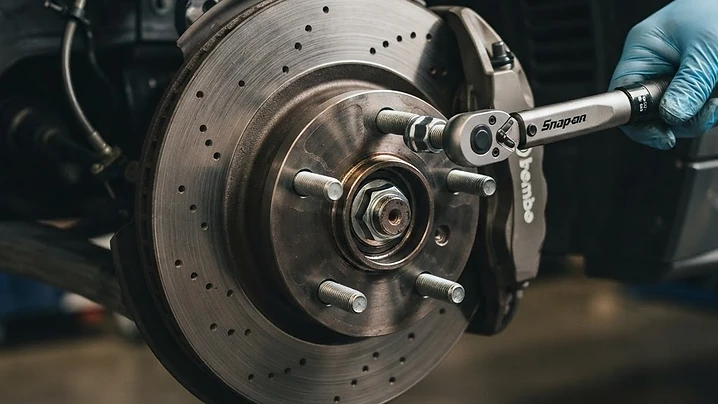
Tightening lug nuts in order around the circle is a guaranteed way to get an uneven mount. The star pattern is the only safe way — here is how and why.
Torque Sequencing: The Star Pattern and Why It Is Non-Negotiable
The star (cross-pattern) torque sequence is not a suggestion — it is the only way to properly seat a wheel against a hub. Torquing the lug nuts in order around the circle is a guaranteed way to get an uneven, dangerous mount.
Why the Star Pattern Exists
When you tighten a lug nut, it pulls the wheel toward the hub on that side. If you tighten in order around the circle, each nut tilts the wheel slightly before the next one pulls it back.
The star pattern alternates opposite sides, pulling the wheel flat against the hub evenly. Each nut clamps the wheel progressively more centered, and by the time you reach the final torque, the wheel is seated perfectly flat.
The Sequence
For a 5-lug wheel:
- Top (12 o'clock)
- Bottom-right (roughly 5 o'clock)
- Top-left (roughly 10 o'clock)
- Bottom-left (roughly 7 o'clock)
- Top-right (roughly 2 o'clock)
For a 4-lug wheel:
- Top
- Bottom
- Left
- Right
For a 6-lug wheel:
- Top
- Bottom
- Upper-right
- Lower-left
- Upper-left
- Lower-right
The pattern is: skip one, tighten one, skip one. If you cannot count, draw a star on the wheel.
The Staged Approach
Proper torquing is done in stages — not all at once to final torque:
- Snug all nuts by hand with the wheel hanging free (do not let it hang on one nut).
- Lower the car so the tire touches the ground but does not take full weight.
- Torque to 50% of spec in the star pattern.
- Torque to 100% of spec in the star pattern.
- After 50 miles, re-torque to spec — the wheel settles as it seats.
Why Impact Guns Are Dangerous
An impact gun has no torque control. It hammers the nut to whatever torque the hammer delivers — which varies with air pressure, battery charge, and how long the trigger is held.
An over-torqued nut stretches the stud beyond its yield point, permanently weakening it. An under-torqued nut loosens over time. Either way, the stud is compromised.
The proper tool is a torque wrench — a calibrated click-type or digital wrench that clicks (or beeps) at the set torque. Always use one for final torque.
The Re-Torque
Aluminum wheels flex and settle under load. The first 50 miles of driving compresses the wheel against the hub, and the lug nuts can loosen by 5-15 lb-ft. Always re-torque after 50 miles. This is not optional — it is the difference between a wheel that stays on and one that does not.
The Rule
Star pattern, staged torque, calibrated torque wrench, re-torque after 50 miles. Skipping any of these steps is a compromise on safety — and a wheel coming off on the highway is the consequence.
Find wheels for your car
Pick your make and model — we'll show you every wheel that fits your bolt pattern.
Get notified when new wheels are listed
New listings drop daily. Be the first to know when wheels for your car hit the marketplace. No spam, unsubscribe anytime.