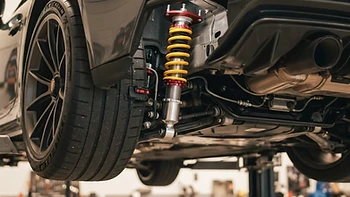
Tire Rotation Reality Check: Managing Directional, Staggered, and Non-Rotatable Setups
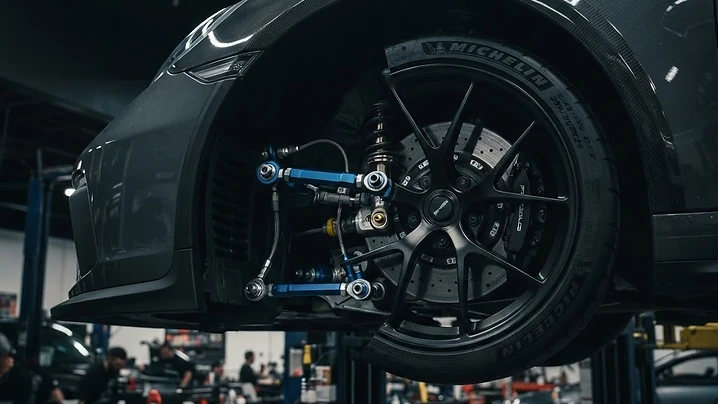
When you cannot rotate tires traditionally, suspension hardware must do the heavy lifting. Here is how to keep directional and staggered fitments wearing flat.
Shop accessories
Browse suspension & hardware
Shop this article
Browse suspension accessories
Crown Automotive Wheel Spacer Set (2), 5 on 5.5"
$178.5

Wheel Spacers 5x112 12mm 66.6mm Hub Centric fits Mercedes
$4.5

Original Gorilla Lock Set - Acorn Bulge - 3/4" Hex - 1/2"-20 Thread Size - Chrome Finish - Set of 5 (71481NB5)
$45

McGard 27226 Chrome Bolt Style Cone Seat Wheel Lock Set (M14 x 1.25)
$44.99
Every driver understands the standard maintenance pitch: rotate your tires every 5,000 to 7,500 miles, swap fronts to rears or run an X-pattern, and your tread will wear out evenly. Telle Tire and the Tire Industry Association routinely cite those intervals for square setups on commuter sedans. But once you fit an aggressive aftermarket package—staggered widths, directional track rubber, or altered wheel offsets—standard maintenance rules break down completely.
When a setup is constrained to one axle, one corner, or one rotational direction, you lose the primary mechanical cheat code for masking chassis misalignments. The tires cannot be shuffled to average out camber scrub or toe drag. At that point, preserving your rubber comes down to suspension geometry, hardware condition, and strict service discipline.
The Three Constraint Classes: What You Can and Cannot Rotate
Tire rotations fall into three distinct mechanical constraints based on carcass construction and wheel fitment:
- Directional, Square Setups: Tread designs cut with dedicated V-grooves for wet-weather evacuation must spin in one rotational direction. You can move them front-to-back along the same side of the vehicle, but crossing axles flips the tread orientation backward, ruining hydroplaning resistance.
- Staggered, Asymmetric/Non-Directional Setups: Common on performance platforms like the BMW 3/4 Series, Ford Mustang, and Nissan Z. The rear tires are substantially wider than the fronts (for example, 275s in the rear and 245s up front). Because front-to-back swaps would compromise clearance and ABS calibration, your only rotation option is side-to-side across the same axle.
- Staggered AND Directional (The Non-Rotatable Setup): A rear-wheel-drive performance vehicle running directional tires on staggered wheels is locked in place. The left-front tire must stay on the left front; the right-rear must stay on the right rear. Unless you dismount the rubber, flip it on the wheel machine, and rebalance—costing $100 to $180 per visit—zero physical rotation can occur.
ROTATION CONSTRAINTS AT A GLANCE
┌────────────────────────┬───────────────────────┬──────────────────────────┐
│ Fitment Type           │ Permissible Movement  │ Primary Vulnerability    │
├────────────────────────┼───────────────────────┼──────────────────────────┤
│ Square + Non-Direct.   │ Forward Cross / X     │ Neglect / Skipped Cycles │
│ Square + Directional   │ Same-Side Front-to-Back│ Side-to-Side Wear Delta  │
│ Staggered + Asymmetric │ Lateral (Side-to-Side)│ Front vs. Rear Burn Rate │
│ Staggered + Directional│ Locked to Corner      │ Uncompensated Alignment  │
└────────────────────────┴───────────────────────┴──────────────────────────┘
The Physics: Why Immovable Tires Die Early
When a tire lives permanently at a single corner, it absorbs identical dynamic loads across every mile. On a front-wheel-drive or high-power all-wheel-drive vehicle, the front axle handles up to 80% of braking force alongside cornering and torque transmission, accelerating tread wear at more than twice the rate of the rear axle. According to data from the NHTSA, tires operated with uneven tread depths compromise wet braking distances significantly once tread drops below 4/32nds of an inch.
On staggered rear-wheel-drive platforms, rear negative camber naturally scrubs the inside shoulder during straight-line travel. On an unrotatable directional setup, you cannot flip that wear to the outside shoulder through normal service. If your suspension components exhibit any compliance or slop, that inside shoulder will scrub down from 10/32nds to corded steel wire in under 8,000 miles.
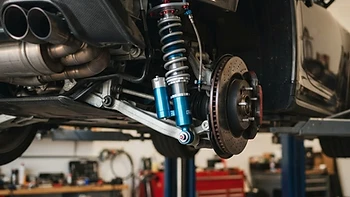
The Suspension Hardware Solution
If you cannot physically rotate your tires to equalize wear, your suspension hardware must hold the contact patch completely flat under dynamic load. As noted by Shop Owner Magazine, suspension compliance directly alters pickup points and induces unintended dynamic toe and camber scrub.
- Camber/Caster Plates and Adjustable Arms: Factory suspension designs rarely offer independent camber and toe adjustment on both axles. Aftermarket adjustable lower control arms and top plates allow technicians to dial alignment down to 0.05-degree tolerances, removing excessive static negative camber that destroys inner shoulders on fixed staggered setups.
- Spherical or Stiff Polyurethane Bushings: Soft OEM rubber bushings compress heavily under hard braking and acceleration. That deflection causes dynamic "toe-out" under load, acting like a cheese grater on inner tread blocks. Upgraded bushings stabilize dynamic alignment angles.
- Adjustable Sway Bar End Links: Misaligned or preloaded anti-roll bars hold an uneven corner weight across an axle, leading to asymmetric tire wear across left-and-right tires on cars with directional setups. Neutralizing preload with adjustable end links ensures cross-axle wear remains symmetrical.
Actionable Rules of Thumb for Constrained Setups
- The 2/32nds Depth Delta Rule: Use a tread depth gauge across all four tires every 3,000 miles. If the difference between the front and rear tread depth (on directional-square setups) or inner-to-outer shoulder depth (on locked staggered setups) exceeds 2/32nds of an inch, intervene immediately. On locked setups, this signals an active alignment shift or failed suspension bushing, not routine wear.
- Tighten the Service Window to 3,500 Miles: High-performance, low-treadwear compounds (UTQG 200–300) running staggered fitments should have lateral-only rotations or full chassis inspections performed at 3,000 to 4,000 miles rather than the conventional 7,500-mile mark.
- Account for Pressure-Induced Camber Wear: Never overlook inflation. Remember the fundamental rule of thumb: tire pressure fluctuates roughly 1 PSI for every 10°F change in ambient temperature. Running even 3 PSI low on a wide, low-profile staggered tire concentrates vehicular mass directly onto the inner shoulder, accelerating unrotatable shoulder wear exponentially.
What to Do Next
- Audit Your Fitment: Confirm your tire and wheel specs. Check the sidewall for rotation directional arrows or "Outside/Inside" asymmetric markings, and verify if your front and rear wheel widths and offsets differ.
- Measure Every Groove: Take three tread depth readings per tire: inside shoulder, center rib, and outside shoulder. Record the figures to identify unmanaged camber or toe scrub before cords show.
- Inspect Suspension Wear Points: Jack up the vehicle and check for torn rubber control arm bushings, weeping dampers, and worn ball joints that induce unmanaged dynamic toe scrub.
- Upgrade to Corrective Hardware: If you run a staggered or directional setup, install adjustable camber/caster plates, adjustable rear toe arms, and stiffer bushings so your alignment tech can lock in flat-wear geometry.
Find wheels for your car
Pick your make and model — we'll show you every wheel that fits your bolt pattern.
Get notified when new wheels are listed
New listings drop daily. Be the first to know when wheels for your car hit the marketplace. No spam, unsubscribe anytime.
Related listings
Browse suspension accessoriesCrown Automotive Wheel Spacer Set (2), 5 on 5.5"
$178.5
Wheel Spacers 5x112 12mm 66.6mm Hub Centric fits Mercedes
$4.5
Original Gorilla Lock Set - Acorn Bulge - 3/4" Hex - 1/2"-20 Thread Size - Chrome Finish - Set of 5 (71481NB5)
$45
McGard 27226 Chrome Bolt Style Cone Seat Wheel Lock Set (M14 x 1.25)
$44.99
Keep reading

Spring Rate, Wheel Rate, and Motion Ratio: The Number on the Spring Isn't the Whole Story
7 min
Sway Bars and Chassis Bracing: Tightening Up the Handling
5 min
Coilovers 101: What to Know Before You Drop Your Ride
6 min