The Winter Wheel Audit: Why Your Rotating Assembly Fails Below 45°F
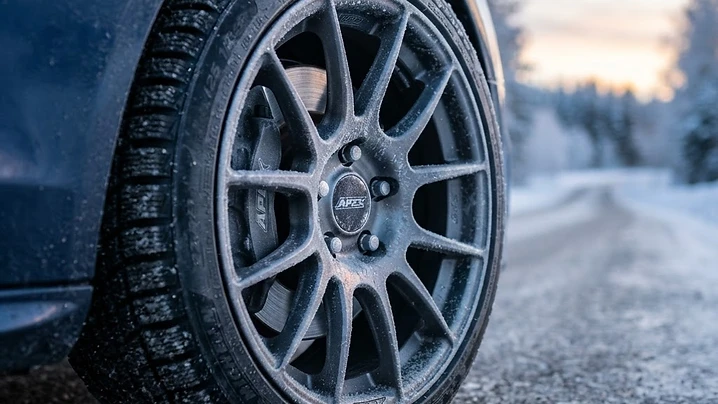
Learn how cold-soak pressure loss, rubber hardening, and salt corrosion impact your vehicle's unsprung mass and safety during the winter months.
Shop complete sets
Wheels + tires, ready to mount
Shop this article
Browse complete wheel sets


The Hidden Physics of the Winter Wheel
When the temperature drops, most drivers only think about their battery or their heater. But as an experienced tech, I can tell you that your wheels—the complete rotating assembly of rim, tire, bearings, and weights—are under the most stress. In the shop, we see a massive influx of customers every November as soon as the first cold snap hits. This isn't just bad luck; it's physics.
Your wheel is a complex system of unsprung mass, which is the weight of everything not supported by your car's springs, including the wheels, tires, and brakes (Wikipedia). In winter, managing this mass is the difference between staying on the road and sliding into a curb.
The 45°F Rule and Rubber Hardening
One of the most critical thresholds in automotive safety is 45°F (7°C). According to Performance Plus Tire, all-season and summer rubber compounds begin to harden significantly once temperatures stay below this mark for seven consecutive days.
When rubber hardens, it loses its ability to conform to the road surface. This turns your tires into hard plastic pucks, drastically increasing braking distances. Winter tires use specialized silica-rich compounds that remain flexible at sub-zero temperatures, ensuring the tread can actually 'bite' into the snow. If you're in the 'Rust Belt' or Northern US, switching to a dedicated winter assembly isn't just a luxury—it's a mechanical necessity for maintaining grip.
Cold-Soak Pressure Loss: The 1 PSI Rule
You’ve likely seen your Tire Pressure Monitoring System (TPMS) light pop on during a chilly morning. This is usually due to cold-soak pressure loss.
The Rule of Thumb: For every 10°F drop in temperature, your tire pressure will decrease by approximately 1 to 2 PSI (Goodyear).
This happens because air is a gas that follows Gay-Lussac’s Law: as the temperature drops, the air molecules move less and occupy less space, exerting less force against the tire walls (YouCanic). A tire set to 35 PSI on a 75°F afternoon can easily drop to 30 PSI on a 25°F morning.
| Temperature Change | Estimated PSI Loss | Impact on Fuel Economy | | :--- | :--- | :--- | | -10°F | 1-2 PSI | -0.3% to -0.6% MPG | | -30°F | 3-6 PSI | -0.9% to -1.8% MPG | | -50°F | 5-10 PSI | -1.5% to -3.0% MPG |
Data derived from NHTSA and Rims & Tires statistics.
Corrosion, Salt, and the Bead Seal
Road salt is the natural enemy of the rotating assembly. While alloy wheels resist rust better than steel, they are prone to pitting and clear coat peeling (Trilli Tires).
More dangerously, salt and moisture can cause corrosion at the bead seat—the point where the tire meets the rim. As the metal oxidizes, it creates an uneven surface that allows air to seep out. In extreme cold, the rubber also contracts and pulls away from the rim, exacerbating these 'bead leaks' (Chicago Tribune). If you find yourself adding air every three days, you likely don't have a nail; you have a corroded bead that needs cleaning and resealing.
Balancing and Unsprung Mass in the Slush
Precision balancing is vital for winter driving. A lost wheel weight or a build-up of frozen slush inside the rim barrel can throw off the balance of your assembly. Because wheels are part of the unsprung mass, any imbalance is felt directly through the steering wheel and can accelerate wear on your wheel bearings.
Bearings are packed with grease that thickens in the cold. If your wheels aren't 'true' (perfectly round without runout), the increased vibration combined with cold-thickened lubricant can lead to premature bearing failure.
What to do next
- Check pressure monthly: Don't wait for the TPMS light. Use a manual gauge to check all four tires and the spare when they are 'cold' (parked for at least 3 hours).
- Inspect tread depth: New tires typically have 10/32" to 11/32" of tread (Chicago Tribune). If you're below 5/32", your snow traction is already compromised.
- Wash your wheels: During winter, use a touchless wash with an underbody spray to flush salt out of the wheel barrels and away from the brake assemblies.
- Torque your lugs: Metal contracts in the cold. Ensure your lug nuts are torqued to your manufacturer's spec (usually 80-100 lb-ft for passenger cars) to prevent them from loosening.
- Switch at 45°F: Plan your seasonal tire swap when the forecast consistently hits 45°F to avoid the first-snow rush at the shop.
Find wheels for your car
Pick your make and model — we'll show you every wheel that fits your bolt pattern.
Get notified when new wheels are listed
New listings drop daily. Be the first to know when wheels for your car hit the marketplace. No spam, unsubscribe anytime.