The Ticking Clock on Your Rims: Why Low Mileage Doesn’t Mean Safe Rubber
Think low mileage means your tires are safe? Learn how to decode DOT dates, spot dry rot, and understand why age—not just wear—is the silent killer of aftermarket and OEM setups.
Shop rims
Browse all available wheels
Shop this article
Browse all rims


The Garage Queen Trap
I see it every week: a customer rolls in with a set of pristine-looking aftermarket wheels they found on a marketplace. The rims are polished, the tread looks deep enough to hide a penny, and the seller swore they only had 5,000 miles on them. But when I look at the sidewall, I see the truth. Those tires are eight years old, and they are effectively ticking time bombs.
In the world of high-end wheels and OEM replacements, we obsess over bolt patterns (PCD) and offsets. But the most critical spec isn't the width of the rim—it’s the age of the rubber wrapped around it. Whether you are buying a used set of forged alloys or dusting off a classic in the garage, understanding tire shelf life is non-negotiable for safety.
Decoding the DOT: The Tire’s Birth Certificate
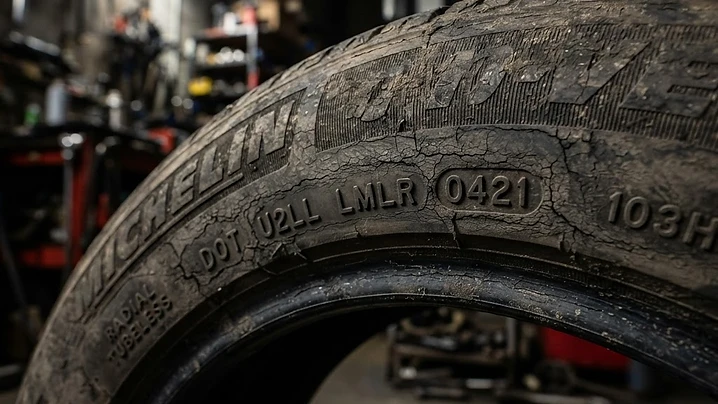
Every tire sold in the U.S. is required by the National Highway Traffic Safety Administration (NHTSA) to have a DOT (Department of Transportation) symbol followed by a series of characters. The last four digits are the most important for any buyer.
- The Format: WWYY (Week and Year).
- The Example: A code ending in
3219means the tire was manufactured in the 32nd week of 2019.
If you see a three-digit code, walk away. That tire was made before the year 2000 and belongs in a museum, not on a highway. Even if the tread depth is a healthy 10/32", the internal structure is likely compromised.
Why Low Mileage Leads to Dry Rot
It sounds counterintuitive, but tires that sit in a garage often degrade faster than tires driven daily. Tires contain anti-ozonant chemicals that keep the rubber pliable, but these chemicals are only released when the tire is in motion—a process called "blooming."
When a vehicle sits, the rubber dries out and reacts with oxygen and UV rays. This leads to dry rot, characterized by hairline cracks in the sidewall or between the tread blocks. According to data from Tyre Dispatch, the risk of visible perishing doesn't just grow linearly; it spikes as the tire hits the middle of its lifespan.
Cracking and Perishing Rates by Age
| Tire Age | Share Showing Cracking/Perishing | | :--- | :--- | | 0 to 3 Years | 6.7% | | 4 to 5 Years | 11.0% | | 6 to 7 Years | 16.4% | | 8 to 9 Years | 30.4% | | 10 to 12 Years | 35.4% |
As the table shows, the failure rate nearly doubles between the 7-year and 9-year marks. This is why most manufacturers and the Rubber Manufacturers Association (RMA) recommend a professional inspection at six years and mandatory replacement by ten years, regardless of tread wear.
The Rule of Thumb: The 1 PSI per 10°F Rule
Temperature is the enemy of aging rubber. A critical rule of thumb for any driver is that tire pressure changes by approximately 1 PSI for every 10°F change in outside temperature.
Why does this matter for old tires? Aged rubber is less flexible. When an underinflated, older tire flexes under load, it generates excessive heat. Because the rubber is already brittle from dry rot, it cannot handle the thermal expansion as well as fresh rubber, leading to catastrophic tread separation. Always check your pressures when the seasons shift; a 30-degree drop in autumn means your tires are suddenly 3 PSI low, increasing the strain on those aging sidewalls.
Fitment and Buying Advice
When you are browsing the RimRevival marketplace for a new setup, don't just look at the bolt pattern (e.g., 5x114.3) or the center bore. If the wheels come with tires, factor the "rubber tax" into your budget.
- Ask for DOT Photos: A reputable seller should provide clear shots of the date codes.
- Inspect the Valleys: Look deep into the tread grooves for small cracks. If you see them, the tires are done.
- Check the "Penny Test": While age is the focus here, the NHTSA reminds us that anything less than 2/32" of tread depth is legally bald and unsafe for wet conditions.
What to do next
- Check your current date codes: Go to your driveway right now and find the 4-digit DOT code on all four tires (and the spare).
- Inspect for "Checking": Use a flashlight to look for fine, spider-web cracks on the sidewalls, especially if the car is parked outdoors in high-UV regions like the Southwest.
- Verify Pressure: Adjust your PSI based on the current ambient temperature to reduce stress on the tire structure.
- Budget for Replacement: If your tires are over six years old, start shopping for replacements now so you aren't forced into an emergency purchase after a blowout.
Find wheels for your car
Pick your make and model — we'll show you every wheel that fits your bolt pattern.
Get notified when new wheels are listed
New listings drop daily. Be the first to know when wheels for your car hit the marketplace. No spam, unsubscribe anytime.