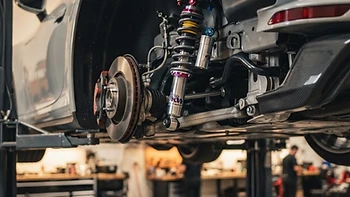
The Secret to Symmetry: Why Corner Balancing is the Final Step for Your Coilover Setup

Installing coilovers is only half the battle; corner balancing ensures your car handles identically in left and right turns by equalizing diagonal cross-weights.
Shop suspension
Browse sport suspension parts
Shop this article
Browse sport suspension
Crown Automotive Wheel Spacer Set (2), 5 on 5.5"
$178.5

Wheel Spacers 5x112 12mm 66.6mm Hub Centric fits Mercedes
$4.5

Original Gorilla Lock Set - Acorn Bulge - 3/4" Hex - 1/2"-20 Thread Size - Chrome Finish - Set of 5 (71481NB5)
$45

McGard 27226 Chrome Bolt Style Cone Seat Wheel Lock Set (M14 x 1.25)
$44.99
Beyond Ride Height: The Pursuit of 50% Cross-Weight
You have finally installed your coilovers, dialed in the ride height, and finished the alignment. Yet, on the track or a spirited backroad, the car feels "off"—it bites harder in left-handers than right-handers, or the nose dives unevenly under heavy braking. This is rarely a hardware failure; it is a balance issue.
Corner balancing is the art of adjusting the individual weight carried by each wheel to ensure the chassis is as neutral as possible OffCamber Autosport. While you cannot change the car's total weight without removing parts, you can shift how that weight is distributed across the four contact patches by adjusting the height of your coilover perches.
Why Diagonal Weight Matters
The primary goal of corner balancing is to achieve a 50% cross-weight. This means the sum of the Right Front (RF) and Left Rear (LR) weights should equal the sum of the Left Front (LF) and Right Rear (RR) weights Trackspec Autosports.
When these diagonal totals are uneven, the car becomes unpredictable. An unbalanced car may:
- Suffer from premature lock-up on one wheel during braking High Performance Academy.
- Exhibit understeer in one direction and oversteer in the other.
- Struggle to put power down evenly when exiting corners.
The Corner Balancing Process
To perform a proper balance, the vehicle must be placed on four individual electronic scales.
- Prepare the Car: The car must be in "race trim." This includes a full tank of fuel (or the level you usually run at the track) and weight in the driver's seat to simulate your presence Corner Balance.
- Level the Surface: Accuracy is paramount. All four scales must be within 1/8 of an inch of level; balancing on an uneven garage floor can actually make your handling worse than the factory setup How To Corner Balance Your Car.
- Adjust the Perches: If the cross-weight is off, you raise or lower the spring perches. To increase weight on a specific corner, you "wedge" the car by raising the perch. To decrease it, you lower the perch.
Actionable Tips for Enthusiasts
- Disconnect Sway Bars: Always disconnect your sway bar end links before scaling. If the bars are under tension, they will preload the suspension and give you false weight readings.
- Height vs. Preload: Use the threaded shock body to adjust height and weight whenever possible. Do not use spring preload to adjust corner weights, as this can reduce droop travel and lead to skittish handling over bumps SLRspeed.
- Tire Pressure: Ensure your tires are set to their hot operating pressures before the car hits the scales, as pressure changes can subtly affect effective ride height.
Corner balancing is the final bridge between a collection of expensive parts and a cohesive, high-performance machine. For any enthusiast shopping for adjustable suspension, it is the most effective way to ensure your investment actually translates to faster lap times.
Find wheels for your car
Pick your make and model — we'll show you every wheel that fits your bolt pattern.
Get notified when new wheels are listed
New listings drop daily. Be the first to know when wheels for your car hit the marketplace. No spam, unsubscribe anytime.
Related listings
Browse sport suspensionCrown Automotive Wheel Spacer Set (2), 5 on 5.5"
$178.5
Wheel Spacers 5x112 12mm 66.6mm Hub Centric fits Mercedes
$4.5
Original Gorilla Lock Set - Acorn Bulge - 3/4" Hex - 1/2"-20 Thread Size - Chrome Finish - Set of 5 (71481NB5)
$45
McGard 27226 Chrome Bolt Style Cone Seat Wheel Lock Set (M14 x 1.25)
$44.99
Keep reading

Sway Bars and Chassis Bracing: Tightening Up the Handling
5 min
Coilovers 101: What to Know Before You Drop Your Ride
6 min
Lowering Springs vs Coilovers: Which Is Right for You?
5 min