The Load Rating Trap: Why Your Aftermarket Wheels Might Be Unsafe
Most enthusiasts focus on offset and bolt patterns, but ignoring wheel load ratings can lead to catastrophic failure. Learn why this hidden spec is the most critical safety factor when buying aftermarket rims.
Shop rims
Browse all available wheels
Shop this article
Browse all rims


The Hidden Safety Metric
When shopping for aftermarket wheels, the conversation almost always revolves around aesthetics: will they poke, will they tuck, or will they clear the calipers? While these are vital for fitment, there is one specification that is frequently overlooked until it is too late: the load rating.
Unlike bolt patterns or center bores, which determine if a wheel will physically mount to your car, the load rating determines if the wheel can actually support the weight of your vehicle under real-world driving conditions. If you install a wheel with a load rating lower than your vehicle’s gross axle weight rating (GAWR), you are essentially driving on a ticking time bomb.
What is Load Rating?
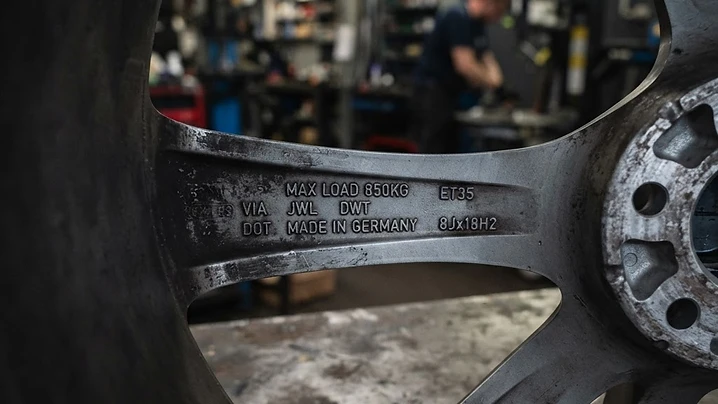
Every wheel is engineered to support a specific maximum weight. This is usually stamped on the back of the spokes or the inner barrel. It represents the maximum load the wheel can carry at its maximum tire pressure.
- The Calculation: To find your minimum requirement, take your vehicle’s heaviest axle weight (usually the front) and divide it by two.
- The Buffer: Always add a safety margin. If your axle weight is 3,000 lbs, you need wheels rated for at least 1,500 lbs each—but 1,600+ lbs is recommended to account for dynamic forces like potholes, hard cornering, and emergency braking.
Why Aftermarket Wheels Fail
OEM wheels are designed specifically for the weight, braking, and suspension geometry of your exact vehicle. When you switch to aftermarket wheels, you are often moving to a "universal" or "multi-fit" design.
- The Weight Gap: A wheel designed for a lightweight compact car might look great on a heavy luxury sedan or a crossover, but it may lack the structural integrity to handle the extra mass.
- The Consequence: An overloaded wheel will not necessarily collapse instantly. Instead, it may develop hairline fractures, experience accelerated metal fatigue, or suffer from deformation that causes constant vibration and alignment issues.
Buyer’s Checklist for Safety
Before you click "buy" on that new set of rims, follow these steps to ensure you aren't compromising your safety:
- Check Your Door Jamb: Locate the tire and loading information placard on your driver’s side door jamb. It lists your vehicle's GAWR.
- Verify the Stamp: Ask the seller for a photo of the back of the wheel. If the load rating is not stamped or provided in the technical specifications, do not buy the wheel.
- Compare Specs: Ensure the wheel’s load rating exceeds your axle weight divided by two.
- Beware of 'Show' Wheels: Some budget-friendly aftermarket wheels are designed purely for aesthetics and may not meet the rigorous testing standards of OEM manufacturers. If the price seems too good to be true, the load rating is often the first thing sacrificed in the manufacturing process.
Don't let a desire for a specific look override the physics of your vehicle. A wheel that fits perfectly but fails under load is a liability you cannot afford.
Find wheels for your car
Pick your make and model — we'll show you every wheel that fits your bolt pattern.
Get notified when new wheels are listed
New listings drop daily. Be the first to know when wheels for your car hit the marketplace. No spam, unsubscribe anytime.