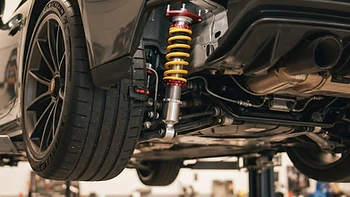
The Last 1% of Performance: A Tech’s Guide to Precision Wheel Balancing

You’ve dialed in your coilovers and picked the perfect forged wheels, but a standard balance won't cut it. Here is why road-force balancing and proper weight selection are non-negotiable for a high-performance track setup.
Shop suspension
Browse sport suspension parts
Shop this article
Browse sport suspension
Crown Automotive Wheel Spacer Set (2), 5 on 5.5"
$178.5

Wheel Spacers 5x112 12mm 66.6mm Hub Centric fits Mercedes
$4.5

Original Gorilla Lock Set - Acorn Bulge - 3/4" Hex - 1/2"-20 Thread Size - Chrome Finish - Set of 5 (71481NB5)
$45

McGard 27226 Chrome Bolt Style Cone Seat Wheel Lock Set (M14 x 1.25)
$44.99
Why Your Suspension Upgrade Feels 'Off'
You just dropped three grand on a set of high-end coilovers and another two on lightweight forged wheels. You expect the car to feel like it’s on rails, but instead, you’ve got a nagging vibration at 75 MPH. As a shop tech, I see this every week. When you stiffen your suspension, you reduce the 'masking' effect of soft factory bushings and long-travel springs. Every imperfection in your wheel and tire assembly is now transmitted directly to your seat and steering wheel.
Achieving a true performance setup requires moving beyond the basic 'spin and clip' balance. You need to understand the physics of how your wheels are weighted and how they interact with the road under load.
Static vs. Dynamic: The Two Planes of Motion
Most entry-level shops perform a static balance, which addresses weight distribution in a single plane. Think of it as a seesaw; the machine finds the heavy spot and places a weight 180 degrees opposite to stop the 'up-and-down' bounce.
However, for performance wheels—especially wider setups common in the 18-inch to 20-inch range—dynamic balancing is the industry standard recommended by organizations like the NHTSA. Dynamic balancing looks at two planes: the inner and outer rim flanges. This corrects 'lateral wiggle' or side-to-side shimmy. If you’re running a staggered setup or wheels wider than 8.5 inches, a static balance is essentially useless for high-speed stability.
The Weight Debate: Clip-On vs. Adhesive
In the performance world, aesthetics matter, but clearance matters more.
- Clip-On Weights: These are the traditional weights you see hammered onto the rim flange. They are fast to install and highly secure, but they are generally reserved for steel wheels or the inner lip of some older alloys. According to Modern Tire Dealer, clip-ons still make up about 60-65% of the aftermarket, primarily due to speed in high-volume shops.
- Adhesive (Stick-On) Weights: These are the go-to for high-end alloy wheels. They sit on the inner barrel, hidden from view.
Tech Tip: If you have upgraded to big brake kits (BBK), you must ensure at least 1/8-inch (3.175mm) of clearance between the brake caliper and the adhesive weights, as noted by Tire Review. Also, if your rim flange is less than 3/16-inch deep, you shouldn't even attempt a clip-on weight; it won't seat properly and will likely fly off at track speeds.
Road-Force Balancing: The Gold Standard
A standard balancer spins the wheel in the air. A Road-Force Balancer (like the Hunter GSP9700) presses a large roller against the tire with up to 1,250 pounds of force, simulating the weight of the vehicle. This detects 'radial force variation'—essentially hard spots in the tire's structure or a wheel that isn't perfectly round.
Discount Tire and other specialists use this to 'match-mount' the tire. By rotating the tire on the rim to align the tire’s stiffest point with the wheel’s lowest spot, we can often reduce the total weight needed by up to 30%, according to Tire Review. For a track car, less lead on the wheel means less unsprung mass and better damper response.
| Balancing Type | Best For | Key Benefit | | :--- | :--- | :--- | | Static | Spare tires, narrow steelies | Fast, addresses vertical bounce | | Dynamic | Standard alloy wheels | Fixes side-to-side steering shimmy | | Road-Force | Low-profile tires, track setups | Identifies structural tire defects |
The Rule of Thumb: The 1 PSI per 10°F Rule
Before you even get to the balancer, your pressures must be right. A concrete rule used by Tire Rack and professional teams is that tire pressure changes by approximately 1 PSI for every 10°F change in ambient temperature.
Why does this matter for balancing? If you set your pressures in a 70°F shop and then head out to a 30°F morning track session, your tires will be 4 PSI low. This changes the tire's footprint and its 'effective roundness' under load. Always check your pressures 'cold' (before driving) to ensure the balance we set in the shop actually translates to the road.
What to do next
- Inspect your barrels: Look for missing adhesive squares or 'weight tape' residue. If you see a clean spot where a weight used to be, your balance is gone.
- Request Road-Force: When buying new rubber for a lowered car, specifically ask for a Road-Force balance. It usually costs $20-$50 more per set, but it’s the only way to guarantee a vibration-free ride with stiff suspension.
- Clean before the shop: If you use adhesive weights, pressure wash the inner barrels of your wheels. Adhesives won't stick to six months of baked-on brake dust, and a tech who has to spend 10 minutes scrubbing your wheels is a tech who might rush the balance.
- Check Caliper Clearance: If you just installed a big brake kit, visually confirm that your wheel weights aren't 'shaving' against the caliper housing.
Find wheels for your car
Pick your make and model — we'll show you every wheel that fits your bolt pattern.
Get notified when new wheels are listed
New listings drop daily. Be the first to know when wheels for your car hit the marketplace. No spam, unsubscribe anytime.
Related listings
Browse sport suspensionCrown Automotive Wheel Spacer Set (2), 5 on 5.5"
$178.5
Wheel Spacers 5x112 12mm 66.6mm Hub Centric fits Mercedes
$4.5
Original Gorilla Lock Set - Acorn Bulge - 3/4" Hex - 1/2"-20 Thread Size - Chrome Finish - Set of 5 (71481NB5)
$45
McGard 27226 Chrome Bolt Style Cone Seat Wheel Lock Set (M14 x 1.25)
$44.99
Keep reading

Spring Rate, Wheel Rate, and Motion Ratio: The Number on the Spring Isn't the Whole Story
7 min
Sway Bars and Chassis Bracing: Tightening Up the Handling
5 min
Coilovers 101: What to Know Before You Drop Your Ride
6 min