The Green Cap Debate: Is Nitrogen Inflation Worth It for Your Aftermarket Wheels?
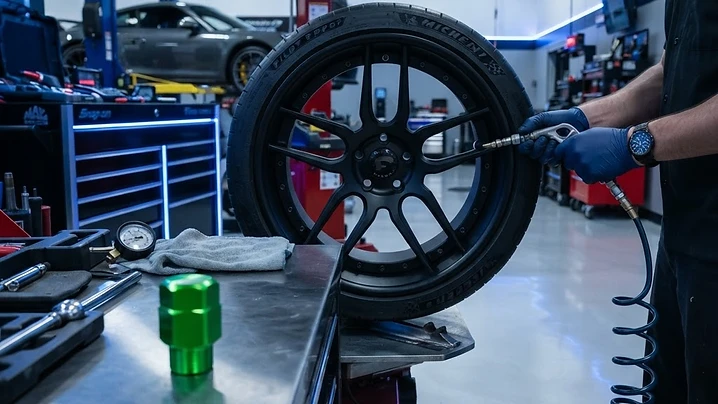
We break down the physics of nitrogen vs. compressed air, helping you decide if that $5-per-tire upgrade actually protects your investment or if it's just hot air.
Shop rims
Browse all available wheels
Shop this article
Browse all rims


The Shop Tech’s Take on the Green Cap
You’ve seen them in the parking lot: those little green valve stem caps. They signify that the tires are filled with nitrogen rather than standard compressed air. If you’re currently shopping for a new set of aftermarket wheels—maybe a staggered fitment for a Dodge Challenger with a 5x115 bolt pattern—you’re going to be asked if you want a nitrogen fill.
As a tech who has mounted thousands of tires, I’ll tell you straight: nitrogen isn't magic, but it isn't a scam either. It’s about stability and moisture control. To understand if it’s right for your setup, we need to look at the physics of what’s happening inside that rim.
The Science of "Lazy" Molecules
Standard compressed air is already about 78% nitrogen and 21% oxygen, with a tiny mix of water vapor and other gases. When we talk about a "nitrogen fill," we are aiming for 93% to 95% purity.
Why bother? It comes down to molecular size. Nitrogen molecules are slightly larger and "lazier" than oxygen molecules. According to Tire Rack, nitrogen reduces the rate of pressure loss through the tire’s rubber (permeation) by about one-third compared to regular air. While the NHTSA notes that tires can lose up to 5% of their pressure per month naturally, nitrogen slows that bleed, keeping your contact patch consistent for longer.
The Rule of Thumb: 1 PSI per 10°F
Every driver should know the 1 PSI per 10°F rule. For every 10-degree drop in ambient temperature, your tire pressure will drop by approximately 1 PSI. This happens because air contracts when cold and expands when hot—a basic law of thermodynamics.
While nitrogen is still a gas and will still fluctuate, it is often delivered from a tank or generator that removes moisture. Water vapor in standard compressed air is the real enemy; it causes much more volatile pressure swings as it changes states from vapor to liquid. For a driver in a climate like the American Midwest, where a 40-degree temperature swing in 24 hours is common, nitrogen provides a more predictable baseline.
| Factor | Compressed Air | Nitrogen (95%+) | | :--- | :--- | :--- | | Pressure Loss Rate | ~1-2 PSI per month | ~0.3-0.5 PSI per month | | Moisture Content | Variable (High) | Extremely Low | | TPMS Sensor Impact | Potential for oxidation | Non-corrosive | | Cost per Fill | Free to $1.50 | $5.00 to $10.00 |
Protecting Your Investment: Wheels and TPMS
If you’ve just dropped $2,000 on a set of forged alloy wheels, the last thing you want is internal corrosion. Standard air compressors often harbor moisture in their tanks. When that wet air is pumped into your tires, it can lead to "wheel rot" or oxidation on the inner barrel of the rim.
More importantly for modern cars, moisture is the primary killer of Tire Pressure Monitoring System (TPMS) sensors. The U.S. Department of Energy points out that even a 1 PSI drop across four tires can reduce fuel efficiency by 0.3%. By using dry nitrogen, you reduce the risk of the TPMS light triggered by moisture-related sensor failure or minor temperature-induced pressure drops.
Who Actually Needs It?
Nitrogen is a smart play for specific demographics:
- The Performance Enthusiast: If you’re running Ultra-High-Performance (UHP) tires on a track, consistent pressure is the difference between a personal best and a greasy slide.
- The "Set It and Forget It" Driver: NHTSA data shows that 28% of light vehicles are running significantly underinflated. If you rarely check your pressure, nitrogen gives you a larger safety buffer.
- The Seasonal Storer: If you have a summer car that sits for six months, nitrogen helps prevent the tires from flat-spotting or losing significant pressure during the off-season.
What to do next
- Check your placard: Always fill to the PSI listed on your driver’s side door jamb, not the "Max PSI" on the tire sidewall.
- Don't fear the mix: If you have nitrogen but your light comes on, you can safely add regular air. It just dilutes the purity; it won't hurt the tire.
- Inspect the valve: When buying new wheels, ensure you use high-quality valve stems. Nitrogen won't fix a physical leak at the rim interface.
- Invest in a gauge: Even with nitrogen, check your pressures once a month. A $15 digital gauge is the best tool in your glovebox.
Find wheels for your car
Pick your make and model — we'll show you every wheel that fits your bolt pattern.
Get notified when new wheels are listed
New listings drop daily. Be the first to know when wheels for your car hit the marketplace. No spam, unsubscribe anytime.