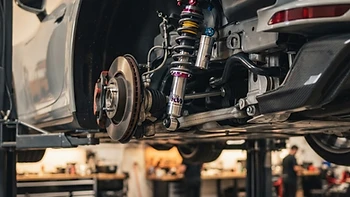
The Bump Steer Ghost: Why Your Lowered Car Darts Over Bumps
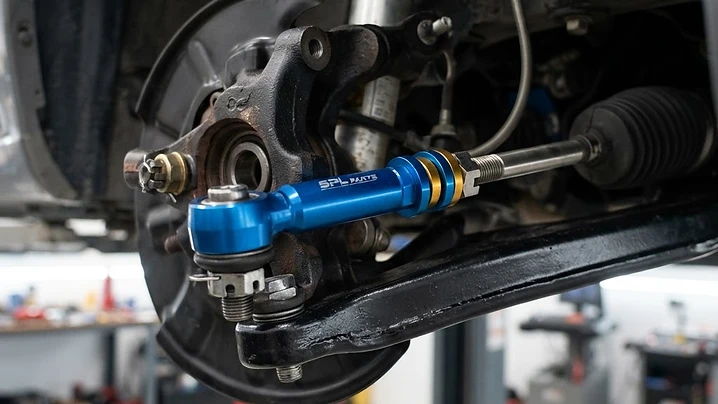
Lowering your car changes more than just the center of gravity. Learn how to diagnose and fix bump steer to regain steering precision and high-speed stability.
Shop suspension
Browse sport suspension parts
Shop this article
Browse sport suspension
Crown Automotive Wheel Spacer Set (2), 5 on 5.5"
$178.5

Wheel Spacers 5x112 12mm 66.6mm Hub Centric fits Mercedes
$4.5

Original Gorilla Lock Set - Acorn Bulge - 3/4" Hex - 1/2"-20 Thread Size - Chrome Finish - Set of 5 (71481NB5)
$45

McGard 27226 Chrome Bolt Style Cone Seat Wheel Lock Set (M14 x 1.25)
$44.99
What is Bump Steer?
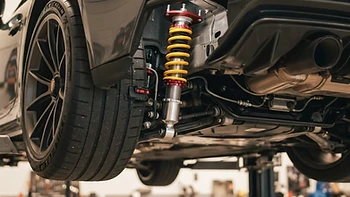
When you lower your vehicle on coilovers or lowering springs, you are fundamentally altering the factory-designed suspension geometry. One of the most common—and dangerous—side effects is bump steer. Simply put, bump steer is the tendency of a wheel to steer itself as it moves through its suspension stroke, independent of any input from the driver or the steering wheel [2][12].
In a perfectly set up car, the wheels should maintain their toe setting as the suspension compresses (bump) or extends (droop). When geometry is compromised, the car may suddenly dart to the left or right when hitting a mid-corner ripple or a highway expansion joint [1][18].
The Geometry of the Arc
To understand why this happens, look at your front suspension. Your wheels are held in place by control arms, while the steering is controlled by tie rods. Both of these components swing in an arc as the suspension moves.
For "zero bump steer," the steering tie rods must travel at the exact same rate and angle as the control arms throughout the full range of travel [13]. When you drop your ride height significantly—often more than 1.5 to 2 inches—the tie rod and control arm are no longer parallel. Their arcs diverge, forcing the wheel to pull inward (toe-in) or push outward (toe-out) as the suspension compresses [3].
Symptoms of Poor Geometry
If you have recently installed performance wheels and coilovers, watch for these red flags:
- Darting: The car feels nervous or "darty" at high speeds on uneven pavement.
- Feedback Jerks: The steering wheel jerks in your hands when one side of the car hits a pothole [18].
- Vague Turn-in: A lack of precision when initiating a corner, caused by the toe angle shifting as the body rolls.
How to Fix and Prevent Bump Steer
While most modern cars have a tiny amount of toe-steer by design, performance lowering often pushes this into a "handling problem" zone [3]. Here is how to correct it:
1. Install a Bump Steer Kit
These kits typically replace the factory tie rod ends with adjustable spherical rod ends and spacers [15]. By adding or removing spacers (shims), you can change the angle of the tie rod to bring it back into a parallel arc with the control arm.
2. Roll Center Adjusters
If your car is extremely low, your control arms may be pointing upward. Roll center adjusters (extended ball joints) help return the control arms to a more horizontal position, which often helps realign the geometry needed to reduce bump steer.
3. Professional Measurement
Measuring bump steer requires a specialized gauge and the removal of the springs to cycle the suspension through its travel. If you are building a dedicated track car, this is a mandatory step for a predictable setup [11].
4. Limit the Drop
For street-driven cars, the most effective way to avoid geometry issues is to limit lowering to 1–2 inches [3]. This keeps the components within a range where the factory geometry can still function effectively without expensive correction hardware.
Find wheels for your car
Pick your make and model — we'll show you every wheel that fits your bolt pattern.
Get notified when new wheels are listed
New listings drop daily. Be the first to know when wheels for your car hit the marketplace. No spam, unsubscribe anytime.
Related listings
Browse sport suspensionCrown Automotive Wheel Spacer Set (2), 5 on 5.5"
$178.5
Wheel Spacers 5x112 12mm 66.6mm Hub Centric fits Mercedes
$4.5
Original Gorilla Lock Set - Acorn Bulge - 3/4" Hex - 1/2"-20 Thread Size - Chrome Finish - Set of 5 (71481NB5)
$45
McGard 27226 Chrome Bolt Style Cone Seat Wheel Lock Set (M14 x 1.25)
$44.99
Keep reading

Sway Bars and Chassis Bracing: Tightening Up the Handling
5 min
Coilovers 101: What to Know Before You Drop Your Ride
6 min
Lowering Springs vs Coilovers: Which Is Right for You?
5 min