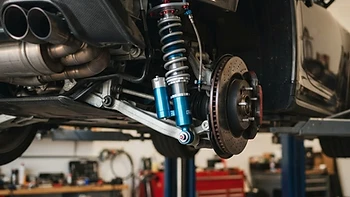
Dialing It In: Why Your Suspension Hardware Dictates Your Alignment
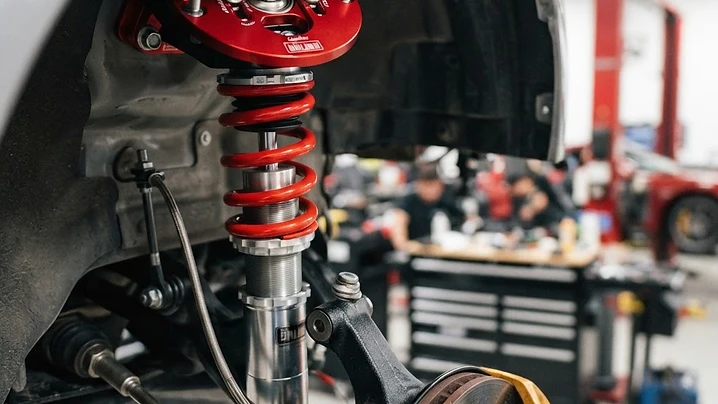
Alignment isn't just a shop service; it's a relationship between your suspension geometry and the road. Learn how hardware upgrades impact your handling and why your car demands a reset after every major change.
Shop accessories
Browse suspension & hardware
Shop this article
Browse suspension accessories
Crown Automotive Wheel Spacer Set (2), 5 on 5.5"
$178.5

Original Gorilla Lock Set - Acorn Bulge - 3/4" Hex - 1/2"-20 Thread Size - Chrome Finish - Set of 5 (71481NB5)
$45

Wheel Spacers 5x112 12mm 66.6mm Hub Centric fits Mercedes
$4.5

McGard 27226 Chrome Bolt Style Cone Seat Wheel Lock Set (M14 x 1.25)
$44.99
The Geometry of Grip
Think of your suspension as the foundation of your car’s performance. When you swap wheels or install lowering springs, you aren't just changing the look; you are fundamentally altering the geometry that keeps your tires planted. Alignment is the process of bringing three critical angles—camber, caster, and toe—back into harmony. If these are off, you aren't just burning through rubber; you’re compromising your vehicle’s ability to track straight and corner safely.
The Big Three: Camber, Caster, and Toe
- Camber: The vertical tilt of your wheels. Negative camber (top of the tire tilted inward) is common in performance setups to improve cornering grip, but excessive negative camber will eat the inner shoulders of your tires. Positive camber (top tilted outward) is rare in modern passenger cars but can improve stability in specific heavy-duty applications.
- Caster: The angle of the steering pivot. Think of it like the front fork of a bicycle. More caster increases high-speed stability and steering self-centering, but it requires more effort to turn the wheel.
- Toe: The most critical setting for tire life. This is the parallelism of your wheels. Toe-in (front of tires pointed toward each other) or toe-out (pointed away) can make a car feel darty or sluggish. According to industry standards, incorrect toe is the leading cause of rapid, uneven tire wear.
When Do You Need an Alignment?
Many drivers wait until the car pulls to one side, but by then, you’ve likely already scrubbed off hundreds of miles of tread life. You must re-align your vehicle if you:
- Install lowering springs or coilovers: Changing ride height alters the arc of your control arms, which shifts your camber and toe settings significantly.
- Swap wheel/tire packages: Different offsets and diameters change the scrub radius and load distribution.
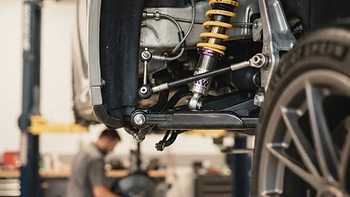
- Replace suspension hardware: Bushings, ball joints, and tie rods are the "joints" of your suspension. If they have play, your alignment settings will shift dynamically while driving.
Hardware That Holds the Line
If you’re pushing your car, factory adjustment ranges often aren't enough. This is where aftermarket hardware comes in:
| Component | Function | Impact on Alignment | | :--- | :--- | :--- | | Camber Plates | Replaces top strut mounts | Allows precise negative camber adjustment | | Adjustable Arms | Replaces fixed control arms | Corrects camber/caster after lowering | | Polyurethane Bushings | Replaces rubber bushings | Reduces deflection for consistent geometry | | Bump Stops | Limits suspension travel | Prevents bottoming out and geometry spikes |
The Golden Rule of Tire Pressure
Before you even think about an alignment, ensure your tire pressures are spot on. A rule of thumb used by technicians is the 1 PSI per 10°F rule. As ambient temperature drops, your tire pressure drops by roughly 1 PSI for every 10 degrees of cooling. Because tire pressure affects the contact patch and ride height, an alignment performed on "cold" tires in a warm shop will be inaccurate once the tires cool down overnight. Always check your pressures when the tires are cold (at least 3 hours after driving) to ensure the alignment rack is measuring the car as it actually sits on the road.
What to do next
- Check your tread: Use a depth gauge. If you see wear on the inner or outer edges (cupping or feathering), your alignment is already compromised.
- Inspect for play: Jack up the car and check for "clunks" or movement in your tie rods and ball joints. If there is play, no alignment machine in the world can fix your handling.
- Get a printout: When you pay for an alignment, demand a "before and after" printout. If the shop can't provide one, they aren't doing the job properly.
- Load the car: If you are setting up a performance vehicle, ensure the fuel tank is full and the driver's seat is weighted to simulate real-world driving conditions before the alignment begins.
Find wheels for your car
Pick your make and model — we'll show you every wheel that fits your bolt pattern.
Get notified when new wheels are listed
New listings drop daily. Be the first to know when wheels for your car hit the marketplace. No spam, unsubscribe anytime.
Related listings
Browse suspension accessoriesCrown Automotive Wheel Spacer Set (2), 5 on 5.5"
$178.5
Original Gorilla Lock Set - Acorn Bulge - 3/4" Hex - 1/2"-20 Thread Size - Chrome Finish - Set of 5 (71481NB5)
$45
Wheel Spacers 5x112 12mm 66.6mm Hub Centric fits Mercedes
$4.5
McGard 27226 Chrome Bolt Style Cone Seat Wheel Lock Set (M14 x 1.25)
$44.99
Keep reading

Sway Bars and Chassis Bracing: Tightening Up the Handling
5 min
Camber, Toe, and Alignment After a Drop: A Setup Guide
6 min
Spring Rate, Wheel Rate, and Motion Ratio: The Number on the Spring Isn't the Whole Story
7 min