Beyond the Spin: The Tech's Guide to Wheel Weights and Road-Force Balancing
Eliminate stubborn highway vibrations with the right combination of wheel weights, dynamic balancing, and road-force diagnostics.
Shop rims
Browse all available wheels
Shop this article
Browse all rims


You just spent good money on new rubber and a clean set of alloy wheels. You torque the lugs, merge onto the interstate, and the moment the needle creeps between 60 and 70 MPH, the steering wheel starts giving you a gentle handshake.
Every week, car owners show up at our bays insisting their new wheels are bent or their suspension bushings are trashed. Most of the time, the culprits are simple: improperly placed wheel weights, reliance on single-plane static balancing, or unmeasured radial tire stiffness variations that only show up when the tire hits the asphalt.
Here is how balancing tech actually works, how to choose between clip-on and adhesive weights, and why road-force diagnosis can save your tires.
Clip-On vs. Adhesive Weights: Protecting the Finish
Wheel weights counteract the inevitable manufacturing high and heavy spots found in even top-tier forged rims and performance radials.
Clip-On Weights
Clip-on weights hammer directly onto the wheel's outer flange (lips).
- The Pros: Mechanically locked into place, highly cost-effective, and placed directly at the rim's widest outer diameter, which offers the most efficient counterweight leverage.
- The Cons: They can gouge, scratch, and crack the clear coat on aftermarket aluminum or powder-coated barrels. In the northern Rust Belt—where states drop thousands of tons of road salt each winter—cracking that finish invites salt and moisture directly under the clear coat, triggering white oxidation pitting.
- Best For: Steel winter beaters and work trucks with traditional steel lip flanges.
Adhesive (Stick-On / Tape) Weights
Adhesive weights rely on high-shear industrial foam tape applied directly to the clean inner barrel of the wheel, hidden behind the spokes.
- The Pros: Completely invisible from a side profile view, non-marring to polished lips, and ideal for modern multi-piece or concave wheels that lack a traditional exterior lip.
- The Cons: Surface prep is non-negotiable. If a technician does not wipe away brake dust, wax, and road grime with isopropyl alcohol before pressing them down, adhesive weights will fling off at highway speeds. They also sit slightly closer to the centerline of the rim, occasionally requiring marginally more mass to offset the same heavy spot.
| Weight Type | Surface Impact | Best Rim Application | Typical Material | | :--- | :--- | :--- | :--- | | Clip-On | Can mar painted/polished lips | Steel rims, work trucks, OEM fleet wheels | Coated steel, zinc | | Adhesive Tape | Non-marring, cosmetic protection | Aftermarket alloys, forged rims, wide lip wheels | Coated zinc, segmented steel |
Static vs. Dynamic Balancing: Why Modern Wheels Require Two Planes
There is a major mechanical difference between balancing a narrow 15-inch steel spare and a modern 19x9.5-inch staggered fitment.
Static Balancing (Single-Plane)
Static balancing treats the wheel assembly as a flat disc. The tire machine looks for vertical hop (up-and-down imbalance). If a heavy spot sits at the top, a counterweight is placed 180 degrees directly across from it.
While this keeps a skinny trailer tire from bouncing off the road, it ignores lateral balance. In automotive shops, static balancing is reserved only for very narrow wheels or emergency field setups.
Dynamic Balancing (Dual-Plane)
Modern vehicles carry wide performance rubber—frequently 245mm to 305mm wide. If the heavy mass is concentrated on the inner shoulder of the tire rather than the outer lip, centrifugal force does not just cause a vertical hop; it creates a side-to-side wobble, technically known as a dynamic couple.
Dynamic balancers spin the assembly and calculate mass requirements across two independent planes: the inner lip and the outer plane behind the spokes. Correcting both planes eliminates lateral steering flutter and preserves suspension ball joints and tie-rod ends.
Road-Force Balancing: When Weight Alone Isn't Enough
Have you ever had a wheel balance out to "0.00 oz / 0.00 oz" on a standard spin balancer, yet the vehicle still vibrates between 60 and 80 MPH?
A standard balancer spins a wheel assembly freely in the air. But tires roll on tarmac carrying thousands of pounds of curb weight.
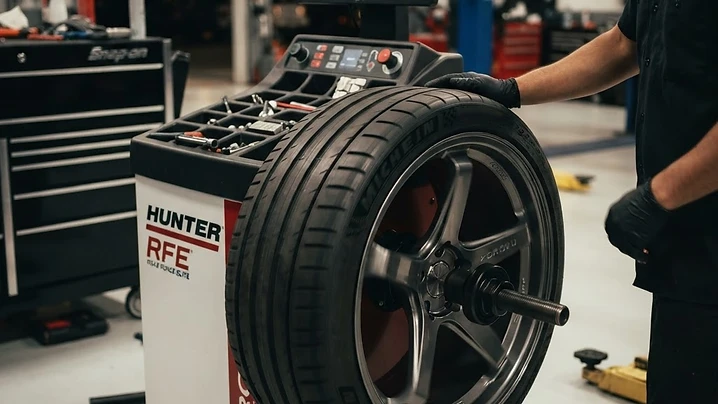
A road-force balancer (such as the industry-standard Hunter Road Force system) lowers a heavy roller directly against the tire tread while it spins, exerting up to 1,200 to 1,400 lbs of radial pressure to simulate real-world conditions.
          [ Hunter Roller: ~1,200 lbs force ]
                         ▼
       +------------------------------------+
       |  (===) Stiff Tire Sidewall (===)   |  <-- Stiff spot creates vibration
       +------------------------------------+
                         ▲
            [ Rim Runout Low Point ]          <-- Force-matched to cancel variation
The Culprit: Radial Force Variation (RFV)
Tires are constructed from plies, overlapping belts, and bead bundles. Even with brand-new tires, some sections of the carcass and sidewall are marginally stiffer than others. When that stiff spot hits the road under vehicle weight, it behaves like an invisible bump, kicking the axle upward even if the tire is geometrically round.
The Fix: Force Matching
Road-force machines measure wheel runout (radial and lateral rim imperfection) and tire stiffness. The technician is instructed to perform force matching:
- The tire is deflated.
- The tire is rotated on the wheel (e.g., indexed 180 degrees) so the tire's stiffest point matches the rim's lowest runout point.
- The assembly is reinflated and re-spun.
The high and low spots cancel each other out, often dropping road force from an intolerable 35 lbs of vibration-inducing variation down to a smooth 10 lbs or less.
The Rule of Thumb: The 15-Minute / 60 MPH Diagnostic Rule
If you experience a steering shake or cabin shudder, use this quick isolation diagnostic before throwing money at new parts:
The Steering vs. Seat Rule: If you feel the vibration through the steering wheel rim, the problem is located in the front axle assemblies. If you feel the vibration humming through the seat cushion or floorboards, the problem sits in the rear axle assemblies.
The Reasoning: Front suspension geometry links directly through the steering rack, tie rods, and column to your hands, telegraphing dynamic front imbalance instantly. Imbalances in the rear tires bypass the steering linkage and translate straight through the rear subframe into the vehicle chassis floor and seat track rails.
What to Do Next
- Inspect your wheel barrels: Look behind your spokes. If you notice bare, oxidized patches of leftover adhesive foam with missing weights, book a re-balance immediately.
- Specify adhesive weights for custom finishes: When dropping off aftermarket, forged, or painted wheels, explicitly request hidden, stick-on tape weights to prevent flange gouging.
- Request road-force balancing for stubborn shakes: If standard spin balancing fails to eliminate vibration above 60 MPH, find a shop with a road-force roller to measure radial force variation and match-mount the tires.
Find wheels for your car
Pick your make and model — we'll show you every wheel that fits your bolt pattern.
Get notified when new wheels are listed
New listings drop daily. Be the first to know when wheels for your car hit the marketplace. No spam, unsubscribe anytime.