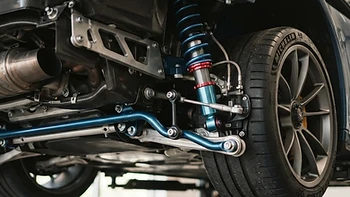
Beyond the Spin: Suspension Geometry, Alignment Angles, and the Upgraded Wheel Assembly
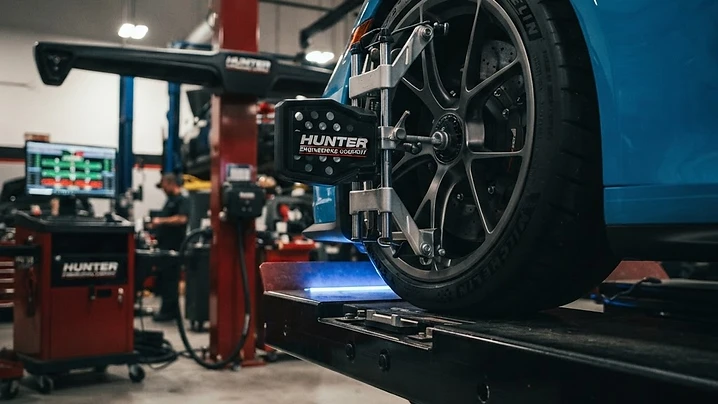
Wheel balancing stops rotation shake, but alignment dictates how your tires meet the pavement. Here is how camber, caster, toe, and modified suspension geometry protect your rolling investment.
Shop complete sets
Wheels + tires, ready to mount
Shop this article
Browse complete wheel sets


You just bolted on a crisp set of flow-formed wheels and fresh rubber. The assembly is spin-balanced to within a tenth of an ounce, the runout checks out true, and the hub-centric rings fit snug against the rotor hats. You merge onto the highway, and while there is zero wheel shimmy, the car drifts toward the ditch and the steering wheel rests slightly cocked to the left.
That isn't a balancing issue. That is chassis geometry fighting your rotating assembly.
Too many drivers treat wheels and tires as isolated hardware. In reality, a wheel is only as good as the suspension links locating it. Let’s break down the mechanical angles that govern your footprint, why an improper setup will torch an $1,100 set of performance tires in under 5,000 miles, and when fresh hardware strictly demands an alignment rack.
The Big Three: Camber, Caster, and Toe
Automotive alignment rests on three primary geometric angles measured in fractions of a degree or fractions of an inch. Each controls a distinct dynamic behavior of your wheel-and-tire package.
1. Camber (Inward/Outward Tilt)
View the car straight on from the bumper. Camber represents the inward or outward tilt of the tire's vertical axis relative to the road surface.
- Negative Camber: The top of the tire tilts inward toward the engine bay. A slight amount (typically -0.5° to -1.5° on modern street sedans and coupes) counteracts cornering centrifugal load, keeping the outer tire flat as the chassis rolls.
- Positive Camber: The top tilts outward. Common on heavy-duty commercial trucks to offset massive cargo loads, but rare on passenger cars.
- The Symptom: Excessive negative camber causes premature wear concentrated entirely on the inner shoulder of the tread. If your tire drops to 2/32” on the inside edge while displaying 6/32” across the rest of the tread, suspect camber.
2. Caster (Forward/Backward Pivot Angle)
Look at the front wheel from the profile/side. Draw an imaginary line down through your upper strut mount (or upper ball joint) through the lower ball joint. Caster is the angle of this steering pivot axis relative to vertical.
- Positive Caster: The steering axis tilts backward toward the driver, placing the tire's ground contact patch behind the steering axis. This creates mechanical trail—the self-centering force that snaps the wheel back to straight-ahead after a turn.
- The Symptom: Caster rarely causes tire wear directly. Instead, cross-caster (an imbalance between left and right sides greater than 0.5°) creates a severe pull toward the side with less positive caster, accompanied by high-speed wandering and twitchy tracking.
3. Toe (Inward/Outward Directional Tracking)
Look down at your front or rear wheels from a bird's-eye view. Toe is the direction the tires point relative to the centerline of the vehicle.
- Toe-In: The leading edges of the tires point toward each other (pigeon-toed).
- Toe-Out: The leading edges point outward away from each other.
- The Symptom: Toe is the ultimate tire killer. Even a fraction of an inch (1/16” or ~0.15°) out of specification drags the tire sideways across the asphalt with every mile. It produces distinct feathering—where the tread blocks develop a sharp, razor-like edge on one side and a rounded edge on the other when you slide your palm horizontally across the tread.
| Alignment Angle | Primary Effect on Vehicle Dynamics | Typical Street Spec Range | Primary Wear Pattern When Out | | :--- | :--- | :--- | :--- | | Camber | Cornering grip, contact patch size | -0.5° to -1.5° (front) | Heavy inner-shoulder wear | | Caster | High-speed stability, steering return | +3.0° to +7.0° | Little to no wear; directional pull | | Toe | Turn-in response, straight tracking | +0.05° to +0.15° (slight in) | Severe tread feathering, rapid scrub |
The Rule of Thumb: The 1/8-Inch Drag Rule
The Rule: Just 1/8-inch (0.125") of total toe misadjustment scrubs your tires sideways across the asphalt by roughly 28 feet for every mile driven.
The Mechanics: Think of your tires rolling straight ahead while your suspension forces them to track diagonally. In a 500-mile highway road trip, an eighth-inch toe misalignment effectively drags the rubber sideways over 2.6 miles. That friction strips 2/32" to 4/32" of tread depth in a fraction of a typical tire’s lifecycle. The National Highway Traffic Safety Administration (NHTSA) frequently flags worn tires as a primary braking hazard, yet premature wear is frequently an alignment failure, not a tire composition flaw.
When Do New Wheels or Suspension Demand a Re-Alignment?
One of the most common counter questions is: “If I just bought new aftermarket wheels with identical rolling diameters, do I really need an alignment?”
Here is how to evaluate your setup:
- Identical Spec Wheels (Direct Swap): If you replace factory 18x8 ET45 wheels with new direct-fit 18x8 ET45 wheels on undamaged suspension components, your static alignment angles remain unchanged. As long as your previous tires wore evenly down to the wear bars, a fresh alignment is an optional safeguard, not a mandate.
- Aggressive Wheel Offset & Track Width Changes: When you change wheel offset significantly (e.g., dropping from a +48mm offset to a +25mm offset), you extend the wheel centerline further away from the hub. This changes the vehicle's scrub radius and increases the leverage ratio applied to the control arms. Dynamic toe changes under braking and acceleration become pronounced, demanding a geometry check.
- Lowering Springs, Coilovers, or Lift Kits: This is an absolute, non-negotiable requirement. Most passenger vehicles use multi-link or MacPherson strut suspensions. Suspension arms do not travel straight up and down; they sweep in predefined arcs. Dropping vehicle ride height by even 1.0" pushes the lower control arms outward and pulls the tie rods, immediately generating unwanted negative camber and toe-out.
Market Context: Why Vehicle Segments Matter
Across North American markets, vehicle architecture changes the alignment equation. Full-size pickup trucks and body-on-frame SUVs (which routinely feature heavy solid rear axles and independent front suspensions) are prone to toe displacement under tow loads and curb impacts. In the Sunbelt, enthusiast setups on European sedans favor aggressive negative camber for cornering, often accepting accelerated inner wear in exchange for lateral grip. Meanwhile, in the Rust Belt and Northeast, annual freeze-thaw cycles create severe pothole damage, turning a $100 alignment check into essential preventative maintenance every spring.
What to Do Next
- Run the Palm Test: Run your hand horizontally across the tread of your front tires. If you feel a directional, saw-toothed "bite" in one direction, your toe is out. Book a rack appointment immediately.
- Allow Springs to Settle: If you just installed lowering springs or coilovers, drive the car 100–150 miles first to allow the spring isolators and bushings to seat before putting the chassis on a laser alignment machine.
- Set Tire Pressures First: Check and equalize cold tire pressures according to your driver door jamb placard (or load table for plus-sized setups) before pulling onto an alignment rack; a 5 PSI differential between sides alters ride height and skews static camber readings.
- Request the Printout: A reputable shop should provide a color before-and-after printout detailing individual camber, caster, toe, and thrust angle against OEM tolerances. Keep it with your vehicle maintenance log.
Find wheels for your car
Pick your make and model — we'll show you every wheel that fits your bolt pattern.
Get notified when new wheels are listed
New listings drop daily. Be the first to know when wheels for your car hit the marketplace. No spam, unsubscribe anytime.
Related listings
Browse complete wheel setsKeep reading

Camber, Toe, and Alignment After a Drop: A Setup Guide
6 minUnderstanding Rims and Tires
4 min
Spring Rate, Wheel Rate, and Motion Ratio: The Number on the Spring Isn't the Whole Story
7 min