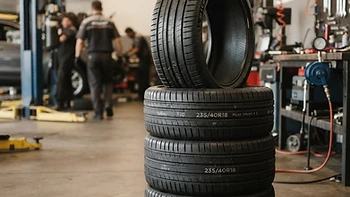
Beyond the Green Cap: The Physics of the Rotating Assembly and the Nitrogen Debate
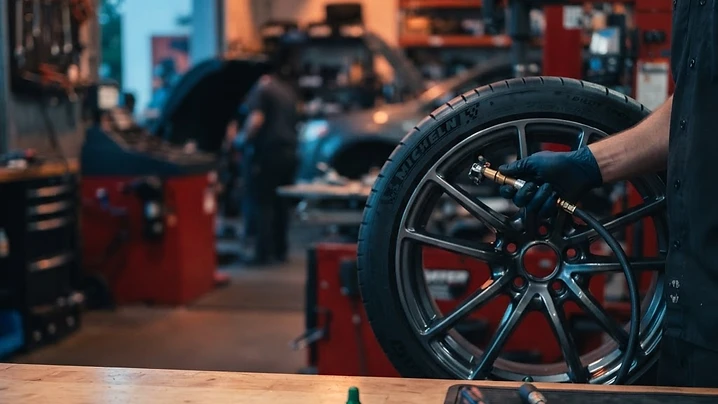
A deep dive into the mechanics of the wheel-and-tire package, exploring how nitrogen inflation, unsprung mass, and assembly trueness impact real-world performance.
Shop complete sets
Wheels + tires, ready to mount
Shop this article
Browse complete wheel sets


The Wheel as a System
When you look at your car, you see four wheels. When a tech looks at your car, they see four high-speed rotating assemblies. This isn't just a piece of metal with rubber wrapped around it; it is a complex system of unsprung mass that dictates how your vehicle accelerates, stops, and handles. Every gram of weight and every pound of pressure matters.
In the shop, we talk a lot about unsprung mass. According to Wikipedia, this is the weight of everything not supported by the suspension—wheels, tires, brakes, and hubs. Because this mass must be moved and controlled by the suspension, reducing it is the fastest way to improve handling. A heavy wheel-and-tire package has more inertia, meaning the engine has to work harder to spin it up and the brakes have to work harder to slow it down. This is why high-performance drivers obsess over forged wheels and lightweight tires.
The Inflation Debate: Nitrogen vs. Compressed Air
You’ve seen the green valve stem caps. They signify nitrogen inflation, a service that usually costs around $5 per tire at shops like Plaza Tire. But what are you actually paying for?
Atmospheric air is already 78% nitrogen and 21% oxygen. The goal of a professional nitrogen fill is to reach a purity of 95% or higher. The primary benefit isn't that nitrogen is "lighter"—in fact, the mass difference is negligible. The benefit lies in the size of the molecules and the absence of moisture.
1. Permeation and Pressure Retention
Nitrogen molecules are physically larger than oxygen molecules. Because of this, they migrate through the microscopic pores of a tire's rubber carcass much slower. Tire Rack notes that nitrogen reduces the loss of tire pressure due to permeation by about one-third compared to regular air. For the average driver who rarely checks their pressure, this is a safety net.
2. The Moisture Factor
Compressed air from a standard shop compressor often contains water vapor. As tires heat up during a drive, that moisture turns to steam, causing unpredictable pressure spikes. Nitrogen is a dry gas. By eliminating moisture, you protect the internal steel belts from oxidation and prevent corrosion on expensive Tire Pressure Monitoring System (TPMS) sensors, a benefit highlighted by Tire Review.
The Rule of Thumb: The 1 PSI per 10°F Law
Whether you use nitrogen or air, you cannot escape the laws of physics. The most important rule for any driver to know is the 1 PSI per 10°F rule.
- The Rule: For every 10° Fahrenheit change in ambient temperature, your tire pressure will change by approximately 1 PSI (or about 2% of total pressure).
- The Reasoning: This is a practical application of the Ideal Gas Law. As air molecules cool, they slow down and take up less space, exerting less force on the tire walls.
In regions like the Midwest or Northeast, a seasonal drop of 30°F can result in a 3 PSI loss overnight. According to the U.S. Department of Energy, every 1 PSI drop across all four tires can reduce fuel efficiency by 0.3%. If you are 10 PSI low—a common occurrence in winter—you are losing 3% of your fuel economy and significantly increasing tread wear.
Balancing, Runout, and True-ness
A rotating assembly must be "true" to function. We measure this in two ways: Balance and Runout.
- Balance: We use lead-free weights to ensure the mass is distributed evenly around the center of rotation. Even a 0.25-ounce imbalance can cause a noticeable vibration at 60 MPH.
- Runout: This is the "roundness" of the assembly. Radial runout is an out-of-round condition (a hop), while lateral runout is a side-to-side wobble. Fleet Equipment Magazine notes that lateral runout can lead a vehicle left and right, causing driver fatigue and uneven wear.
| Feature | Compressed Air | Nitrogen (95%+) | | :--- | :--- | :--- | | Cost | Free to $1.00 | $5.00 - $10.00 per tire | | Pressure Loss | ~1-2 PSI per month | ~0.5 PSI per month | | Moisture Content | Variable (High) | Near Zero | | Availability | Universal | Specialized Shops | | TPMS Protection | Low | High |
What to do next
- Check your placard: Look at the sticker inside your driver’s side door jamb for the manufacturer’s recommended cold PSI. Never use the "Max Press" listed on the tire sidewall for daily driving.
- Audit your caps: If you have green caps, stay with nitrogen to maintain purity. If you need to add air in an emergency, do it—mixing air and nitrogen is safe, though it dilutes the benefits.
- Watch the thermometer: When the first cold snap hits, check your pressures. Expect to add air to compensate for the 1 PSI per 10°F drop.
- Feel for vibrations: If you feel a shake in the steering wheel, it’s likely the front assembly balance. If you feel it in your seat, check the rears.
- Torque your lugs: Always re-torque your lug nuts to the manufacturer's spec (usually 80-100 lb-ft for cars) after 50 miles of driving on a new assembly to ensure the wheel is seated truly against the hub.
Find wheels for your car
Pick your make and model — we'll show you every wheel that fits your bolt pattern.
Get notified when new wheels are listed
New listings drop daily. Be the first to know when wheels for your car hit the marketplace. No spam, unsubscribe anytime.