Backspacing vs. Offset: How to Ensure Your New Wheels Clear Your Suspension
Understanding the difference between backspacing and offset is the key to avoiding suspension rub. Learn how to measure your clearance and choose the right specs for a perfect fit.
Shop rims
Browse all available wheels
Shop this article
Browse all rims


The Hidden Fitment Factor
You have confirmed the bolt pattern and the diameter, but there is a common trap that catches even seasoned enthusiasts: inner clearance. While offset is the most discussed measurement, backspacing is the metric that actually determines whether your wheel will collide with your struts, control arms, or brake lines.
Defining the Terms
To get the fitment right, you must understand how these two measurements interact:
- Wheel Offset: This is the distance from the wheel's mounting face to its true centerline, measured in millimeters. A positive offset tucks the wheel inward, while a negative offset pushes it out toward the fender Wheel Offset & Backspacing Explained (With Charts) | TrailBuilt Off-Road.
- Backspacing: This is the distance from the mounting surface to the back outermost edge of the wheel, measured in inches Backspacing is measured in inches and tells you how much clearance you have between the wheel and suspension components..
While offset tells you where the wheel sits in relation to its own center, backspacing tells you exactly how much of the wheel is hanging off the back of the hub and into your wheel well.
Why Backspacing Matters for Clearance
If you are upgrading to a wider wheel, the offset might stay the same, but the backspacing will increase. For example, an 8-inch wide wheel and a 9-inch wide wheel both with a 0mm offset will sit differently. The 9-inch wheel will have an extra half-inch of aluminum reaching toward your suspension components. This is why backspacing is the critical measurement for knowing how much clearance you have before you experience the dreaded "rub."
How to Measure Backspacing at Home
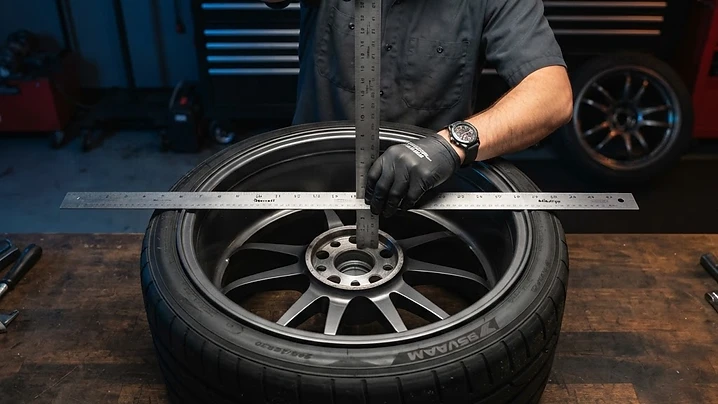
You do not need expensive tools to verify a wheel's backspacing. Follow this simple two-step process HOW TO MEASURE FOR PROPER WHEEL AND TIRE FITMENT INSTRUCTION SHEET:
- Position the Wheel: Lay the wheel face-down on a flat, non-abrasive surface (like a piece of carpet or cardboard) so the back side faces up.
- Measure the Drop: Lay a straightedge across the back flange of the wheel. Use a ruler to measure the vertical distance from the bottom of the straightedge down to the wheel's mounting pad.
Actionable Buying Tips
- The +1 Rule: When calculating backspacing from wheel width, remember that a wheel's advertised width (e.g., 9 inches) is the distance between the bead seats. The actual physical width is usually about one inch wider due to the thickness of the lips Wheel Offset and Backspacing: Enhancing Performance and Style.
- Check Full Lock: When testing fitment, always have a friend turn the steering wheel to full lock in both directions. Clearance often disappears when the suspension is compressed or the wheels are turned Aftermarket Wheel Essentials Guide.
- Know Your Limits: Most modern independent front suspensions (IFS) are very sensitive to backspacing changes. Increasing backspacing too much will cause the inner lip of the rim to scrape the tie rod ends or control arms.
Find wheels for your car
Pick your make and model — we'll show you every wheel that fits your bolt pattern.
Get notified when new wheels are listed
New listings drop daily. Be the first to know when wheels for your car hit the marketplace. No spam, unsubscribe anytime.