Using 3D Scanning to Reproduce Discontinued Wheels
When a wheel is discontinued and cannot be found, 3D scanning offers a way to reproduce it exactly. Here is how the process works and what it costs.
Using 3D Scanning to Reproduce Discontinued Wheels
3D scanning has revolutionized the reproduction of discontinued wheels. What once required manual measurement, guesswork, and trial-and-error machining can now be captured digitally and reproduced with precision. Here is how the process works.
The Problem
When a wheel is discontinued, there is no source for a replacement. If you have a set of four and one is damaged, you are stuck — the manufacturer does not make it anymore, and the used market may not have a match.
Traditionally, your options were:
- Find a used replacement — if you can find one in the right size, offset, and condition.
- Modify a similar wheel — machine a different wheel to fit, with uncertain results.
- Give up — replace all four wheels with a current design. 3D scanning adds a fourth option: reproduce the exact wheel.
The 3D Scanning Process
Step 1: Scan the Wheel
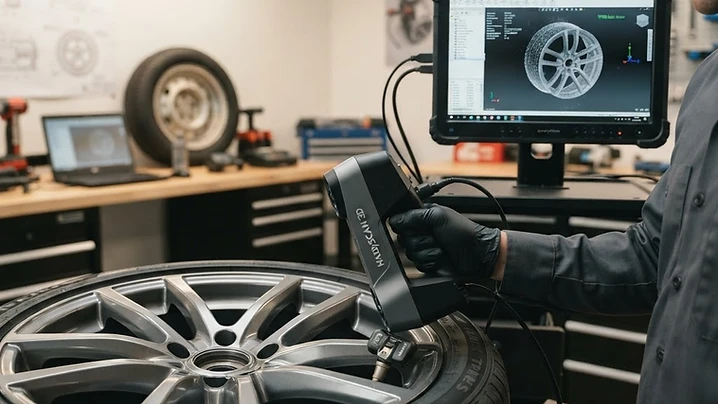
A 3D scanner (structured light or laser) is passed over the wheel, capturing its geometry as a point cloud. The scanner captures the outer face, the barrel, the mounting surface, and the lug holes — every surface.
Step 2: Process the Scan
The point cloud is converted to a 3D mesh — a digital model of the wheel. The model is cleaned up: scan artifacts are removed, holes are filled, and the geometry is verified against manual measurements.
Step 3: Reverse-Engineer the Model
The mesh is converted to a solid CAD model. This is not a copy of the scan — it is a clean, parametric model that can be manufactured. The engineer can adjust the model: add material for machining tolerance, correct minor imperfections, or modify the design while preserving the original dimensions.
Step 4: Manufacture
The CAD model is used to CNC-machine a new wheel from billet aluminum. The process:
- Billet — a block of 6061-T6 aluminum is chosen.
- Roughing — the CNC removes most of the material, leaving the rough shape.
- Finishing — a second pass with finer tooling produces the final geometry.
- Surface finishing — polishing, anodizing, or powder coating.
The result is a one-off reproduction of the discontinued wheel — in many cases, stronger than the original because it is machined from billet rather than cast.
The Benefits
Exact Reproduction
The scanned model captures the original geometry to within 0.001 inch. The reproduction fits exactly as the original did — same offset, same bore, same lug pattern.
Stronger Than the Original
Billet-machined wheels are forged from solid aluminum. The grain structure is uniform, and the material is typically stronger than the cast original. The reproduction may be heavier (more material) but stronger.
Customization
The CAD model can be modified before manufacturing. You can change the offset slightly, add or remove material for clearance, or adjust the design while preserving the original's dimensions and fitment.
The Limitations
Cost
A one-off billet wheel costs $500-1500 per wheel — far more than a cast replacement. This is practical for a rare, valuable wheel where no replacement exists, not for a common wheel where a used option is available.
Material Differences
The billet reproduction may look slightly different from the original cast wheel — the surface finish, the grain, and the weight distribution may vary. For a concours restoration, this may matter; for a driver, it does not.
Only as Good as the Scan
The reproduction is only as accurate as the scan. A wheel that is bent, corroded, or worn will produce a reproduction with the same imperfections. The engineer must clean up the model to produce a correct wheel.
The Takeaway
3D scanning makes it possible to reproduce any wheel — no matter how rare or how long discontinued. The process captures the geometry digitally, reverse-engineers a clean CAD model, and CNC-machines a billet reproduction. It is expensive ($2000-6000 for a set of four), but for a wheel that cannot be found any other way, it is the only option — and the result is often stronger and more precise than the original.
Find wheels for your car
Pick your make and model — we'll show you every wheel that fits your bolt pattern.
Get notified when new wheels are listed
New listings drop daily. Be the first to know when wheels for your car hit the marketplace. No spam, unsubscribe anytime.