The 'Flow Forged' Marketing Trap: Decoding Wheel Manufacturing Labels

Don't let clever branding fool you into overpaying. Learn the structural differences between cast, flow-formed, and fully forged wheels to choose the right upgrade for your build.
The Confusion of Modern Wheel Branding
When browsing the RimRevival marketplace, you will encounter a dizzying array of terms: gravity cast, rotary forged, flow-formed, and monoblock forged. For many enthusiasts, the term "Flow Forged" suggests a premium forged product at a bargain price. However, from a materials science perspective, "flow forged" is a marketing term for a hybrid process, not a true forging. Understanding these manufacturing nuances is the difference between buying a wheel that survives a track day and one that cracks on a pothole.
1. Cast Wheels: The Baseline
Most OEM and entry-level aftermarket wheels are made via gravity casting or low-pressure casting. Molten aluminum is poured into a mold and cooled.
- The Science: Because the metal is not under significant pressure, the molecular structure is random and can contain microscopic porosity (air bubbles).
- The Trade-off: These wheels must be thicker and heavier to achieve the necessary strength, which increases unsprung weight and dulls suspension response.
2. Flow Forming: The "Hybrid" Middle Ground
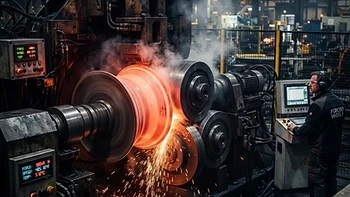
This is where the marketing gets murky. Terms like "Flow Forged" or "Rotary Forged" actually refer to flow forming. The process starts with a low-pressure cast "preform" that looks like a thick, stubby wheel. The preform is placed on a machine that spins it at high speeds while hydraulic rollers heat and stretch the barrel.
- The Science: The rolling process compresses the aluminum in the barrel, aligning the grain structure and increasing tensile strength.
- The Reality: While the barrel gains forged-like properties, the wheel face and spokes remain cast. If you hit a curb, the barrel might hold, but the cast spokes are still susceptible to brittle failure.
3. Fully Forged: The Gold Standard
A true forged wheel never sees a mold. It begins as a solid billet of 6061-T6 aerospace-grade aluminum. This billet is subjected to extreme heat and upwards of 10,000 tons of pressure to crush the metal into a rough shape before it is CNC-machined into the final design.
- The Science: The intense pressure eliminates porosity and forces the grain flow to follow the shape of the wheel. This creates a part that is significantly lighter and more ductile (it will bend before it snaps) than any cast or flow-formed alternative.
Buyer’s Checklist: Which One Do You Need?
- Daily Driving: High-quality low-pressure cast wheels from reputable brands are perfectly safe and cost-effective.
- Spiritied Street/Occasional Track: Flow-formed wheels offer the best "bang for your buck," reducing rotational mass where it matters most (the outer barrel) without the $4,000+ price tag of forging.
- Competitive Racing/High-End Builds: Fully forged is the only choice. Look for the "6061-T6" designation and CNC tool paths on the back of the spokes as proof of authenticity.
- The Price Test: If a "forged" wheel costs less than $600 per corner, it is almost certainly flow-formed. True forged wheels require expensive tooling and long machining times that dictate a higher market price.
Find wheels for your car
Pick your make and model — we'll show you every wheel that fits your bolt pattern.
Get notified when new wheels are listed
New listings drop daily. Be the first to know when wheels for your car hit the marketplace. No spam, unsubscribe anytime.