Laser Wheel Alignment vs String Alignment
Laser and string alignment are the two main approaches — and each measures something slightly different. Here is when to use which and why both work.
Laser Wheel Alignment vs String Alignment
Wheel alignment has two main approaches in the modern era: laser alignment machines (the standard at tire shops) and string alignment (the standard at race shops). Both work — but they measure different things, and understanding the difference matters.
What Alignment Measures
Alignment sets three angles at each wheel:
Toe
The angle the tire points inward (toe-in) or outward (toe-out) from straight ahead. A small amount of toe-in is typical for stability; toe-out sharpens turn-in.
Camber
The tilt of the top of the tire inward (negative) or outward (positive). Negative camber improves cornering grip; too much causes inner-edge wear.
Caster
The forward/backward tilt of the steering axis. More caster gives more self-centering and straight-line stability but heavier steering.
Laser Alignment
How It Works
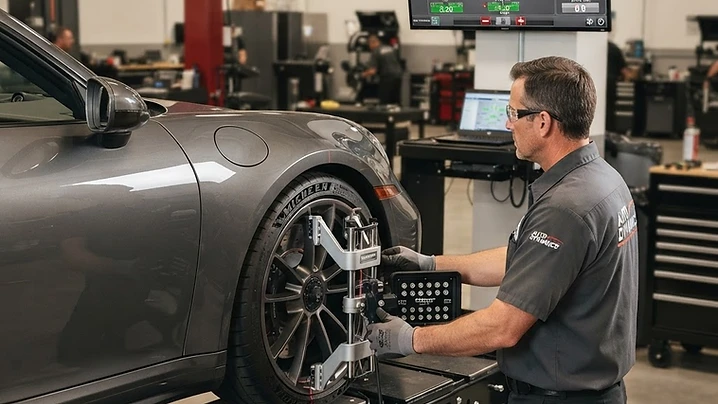
Laser alignment machines (Hunter, Beissbarth) mount targets on each wheel. Lasers project onto the targets, and the machine's computer calculates the angles from the laser positions. The system is fast, precise, and digital.
Strengths
- Speed — a full alignment takes 30-45 minutes.
- Precision — measures to 0.01 degree.
- Full vehicle — measures all four wheels simultaneously.
- Documentation — before and after printouts.
Limitations
- Requires a flat rack — the machine must be calibrated level.
- No dynamic measurement — it measures static alignment only.
- Sensor targets can be knocked — a bumped target gives false readings.
- Ride height matters — the car must be at correct ride height for accurate camber readings.
String Alignment
How It Works
String alignment uses parallel strings stretched alongside the car at hub height. The string is a reference line — you measure from the string to the front and back of each wheel to calculate toe. Camber is measured with a digital camber gauge; caster is calculated from camber changes as the wheel is turned.
Strengths
- No machine needed — strings, jack stands, and a camber gauge. $50 in tools.
- Works anywhere — no flat rack required. The floor can be imperfect.
- Measures the car, not the hub — string alignment measures the wheel face relative to the car's centerline, which is what actually matters on the track.
- Transparent — you can see every measurement and understand the source.
Limitations
- Slower — 90-120 minutes for a full four-wheel alignment.
- Requires skill — the technique takes practice.
- Less precise for toe — string alignment measures to about 0.05 degree, vs 0.01 for laser.
- No caster reading directly — caster is calculated from camber changes.
Which to Use
Street Cars
Laser alignment at a reputable shop is the right choice. It is fast, precise, and documented. The before/after printout confirms the work was done correctly.
Track Cars
String alignment is the standard in motorsport for three reasons:
- It works in the paddock — no flat rack, no calibration.
- It measures the wheel face — string alignment is based on the wheel's contact surface, not the hub.
- It is repeatable — once you learn the technique, you can set the same alignment every time.
Many race teams use laser for the initial setup and string for trackside adjustments.
Lowered and Modified Cars
Laser alignment machines have limits on how low a car can be — the targets may not clear the fender. For lowered cars, string alignment or a laser machine with extra-long adapters is required.
The Common Mistake
The most common alignment mistake is not checking ride height before reading camber. A lowered car that is not settled (suspension hanging) will have different camber than the same car sitting at ride height. Always settle the suspension by bouncing the car and rolling it forward and back before measuring.
The Takeaway
Laser for speed and documentation; string for portability and trackside. Both can produce a correct alignment — the quality comes from the technician, not the tool. A good alignment shop will use the laser machine correctly; a good race engineer will use strings. Neither is a substitute for understanding what the numbers mean.
Find wheels for your car
Pick your make and model — we'll show you every wheel that fits your bolt pattern.
Get notified when new wheels are listed
New listings drop daily. Be the first to know when wheels for your car hit the marketplace. No spam, unsubscribe anytime.