The Future of Airless Tires and Wheel Design
Airless tires have been in development for over a decade and solve real problems — but they change wheel design fundamentally. Here is the state of the technology.
The Future of Airless Tires and Wheel Design
Airless tires — also called non-pneumatic tires (NPT) — have been in development for over a decade. Companies like Michelin, Bridgestone, and Goodyear have all shown prototypes. The question is whether they will replace pneumatic tires on passenger cars, and what that means for wheel design.
What Airless Tires Are
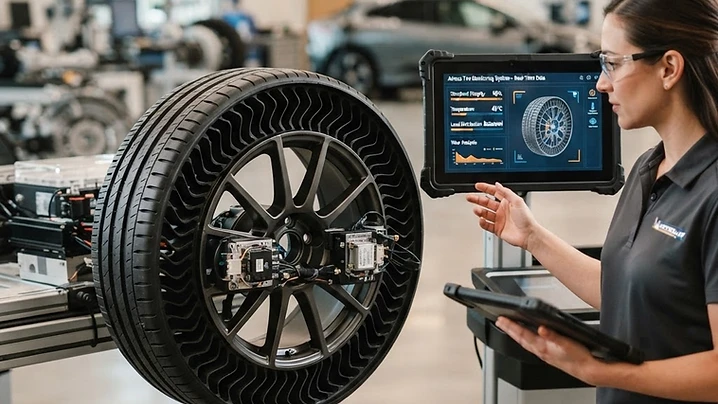
An airless tire replaces the air pressure that holds a tire up with a structural support — typically a web of flexible spokes or fins inside the tire. The tread sits on top; the structure carries the load.
The Advantages
- No flats — there is no air to lose. You cannot get a puncture that deflates the tire.
- No pressure maintenance — no checking, no inflating, no TPMS needed.
- Lower sidewall weight — the structure is lighter than the mass of air and reinforced sidewalls.
- Recyclable — Michelin's Uptis is made entirely of recyclable materials.
- Run-flat by design — it cannot go flat, so it is inherently a run-flat.
The Disadvantages
- Rolling resistance — the structure deforms as it rolls, consuming energy. Current airless tires have higher rolling resistance than pneumatic tires, reducing fuel economy and EV range.
- Weight — the support structure adds weight, offsetting the savings from eliminating air.
- Heat — the flexing structure generates heat, limiting sustained high-speed use.
- Ride quality — the structure is stiffer than an air cushion, transmitting more road harshness.
- Debris trapping — the open spoke structure can collect rocks and debris between the spokes.
- Cost — airless tires are more expensive to manufacture than pneumatic tires.
Current State of Development
Michelin Uptis
Michelin's Unique Puncture-proof Tire System (Uptis) has been in development since 2005 and is being tested on fleet vehicles. It uses an aluminum wheel with a bonded flexible structure. Michelin has announced production intent for passenger vehicles, but no firm timeline.
Bridgestone Air Free
Bridgestone's air-free concept uses thermoplastic resin spokes. It has been tested on bicycles and small vehicles but has not reached passenger car production.
Goodyear
Goodyear has shown multiple airless concepts, including the Eagle 360 spherical tire for autonomous vehicles. These are concept designs, not production tires.
What It Means for Wheel Design
Airless tires change the relationship between the wheel and tire:
The Wheel Becomes the Structure
In an airless tire, the wheel is not just a mounting surface — it is part of the load-carrying structure. The tire's support is bonded to the wheel. This means:
- Wheels and tires are sold as a unit — you do not buy tires separately.
- Wheel damage means tire replacement — you cannot just replace the tire.
- Customization is limited — the wheel and tire are designed together.
Different Materials
Airless tire wheels may use different materials — the bonded structure may require specific surface treatments or thermal properties. Aluminum may be replaced by composites or engineered plastics.
No Tire Pressure
TPMS, valve stems, air compressors, pressure gauges — all become obsolete. The entire ecosystem of tire pressure maintenance disappears.
When Will They Arrive?
The industry consensus is that airless tires will appear first on:
- Fleet and delivery vehicles — where flat tires are costly and the higher rolling resistance is offset by eliminating downtime.
- Low-speed vehicles — golf carts, neighborhood electric vehicles, industrial equipment.
- Autonomous vehicles — where maintenance-free operation is a priority.
- Passenger cars — last, when the rolling resistance, weight, and cost challenges are solved.
Realistic estimates put passenger car airless tires at 2030-2035 — and they may never fully replace pneumatic tires for performance applications, where the air cushion's ride quality and grip characteristics are difficult to replicate with a solid structure.
The Takeaway
Airless tires solve a real problem — punctures and pressure maintenance — but introduce new challenges in rolling resistance, weight, and ride quality. They will likely appear on fleet and low-speed vehicles first, with passenger cars following over the next decade. When they arrive, they will change wheel design fundamentally — the wheel and tire become one unit, and the entire tire-pressure ecosystem disappears.
Find wheels for your car
Pick your make and model — we'll show you every wheel that fits your bolt pattern.
Get notified when new wheels are listed
New listings drop daily. Be the first to know when wheels for your car hit the marketplace. No spam, unsubscribe anytime.