The Evolution of Wire Wheel Construction
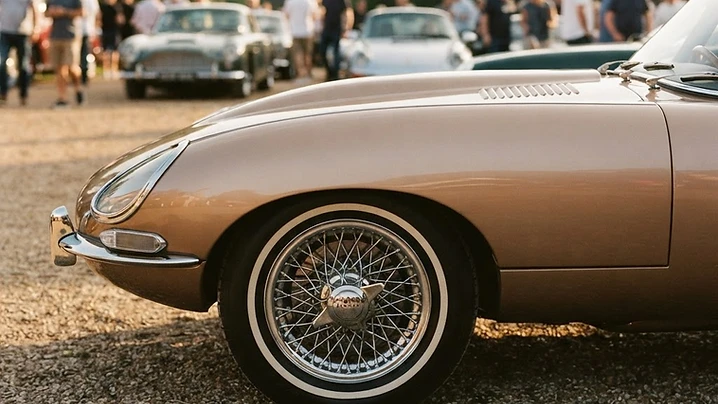
From bicycle-spoke origins to knock-off racing hubs, wire wheels evolved over a century. Here is how they changed, why they need tubes, and what to check when buying.
Shop vintage
Browse vintage OEM wheels
The Evolution of Wire Wheel Construction
Wire wheels are among the oldest wheel designs still on the road — and their construction evolved dramatically over a century. From the early bicycle-spoke designs to the knock-off racing wheels of the 1960s, here is how wire wheels changed and why the differences matter.
The Early Era: 1900s-1930s
The first wire wheels were essentially bicycle wheels scaled up. Thin steel spokes tensioned between a central hub and a steel rim. The spokes carried the load purely in tension — the wheel held together because every spoke was pulling the rim toward the hub.
Characteristics
- Many thin spokes — 60-80 per wheel
- Steel rim — riveted or welded
- Tensioned — each spoke adjusted individually with a nipple
- Tube-type tires — the rim was not airtight
These wheels were light and resilient but required constant maintenance. Spokes loosened from vibration, and the wheel went out of true.
The Golden Age: 1940s-1960s
Post-war wire wheels reached their peak. The best-known examples are the British Daytons and the European Borranis — hand-laced wheels on Jaguar, Aston Martin, and Ferrari sports cars.
Knock-Off Hubs
The most iconic feature of this era was the knock-off hub — a large winged spinner that secured the wheel to the hub. The spinner was tightened by hand (or with a lead hammer) and held the wheel by friction against a tapered hub. To remove the wheel, you knocked the spinner counter-clockwise (on the left side) or clockwise (on the right — reverse threads to prevent loosening from rotation).
Chrome-Plated Spokes
Premium wheels from this era used stainless or chrome-plated spokes. The bright, mirror finish was a hallmark of quality — and required constant polishing to maintain.
Tube-Type Only
Wire wheels require tube-type tires. The spoke tension is maintained through the rim, which is not airtight. Running tubeless on a wire wheel leads to slow leaks through the spoke nipples.
The Maintenance Challenge
Wire wheels require more maintenance than any other wheel type:
- Spoke tension must be checked and adjusted periodically — a wheel with loose spokes is structurally compromised.
- Truing — the wheel must run true; a wobbly wire wheel vibrates and can crack spokes.
- Nipple corrosion — the spoke nipples can seize in the rim, making adjustments impossible.
- Cleaning — every spoke must be cleaned individually; dust and grime accumulate between spokes.
The Modern Era: 1970s-Present
After the 1960s, wire wheels fell out of favor for performance use — alloy wheels were lighter, stronger, and required no maintenance. But wire wheels survived in three niches:
1. Classic Car Restorations
Restored British and European sports cars retain wire wheels for authenticity. Companies like Dayton and Buffalo still manufacture new wire wheels for classic applications.
2. Luxury and Custom
Some luxury and custom builders use wire wheels for their aesthetic — the chrome-spoke look is iconic on lowriders and custom luxury cars.
3. Motorcycles
Wire-spoke wheels are still common on dual-sport and vintage-style motorcycles, where the flexibility of the spoked design absorbs off-road impacts.
Buying Vintage Wire Wheels
When buying vintage wire wheels:
- Check spoke tension — pluck each spoke like a guitar string. They should all ring at a similar pitch. A dull thud means a loose spoke.
- Look for cracked spokes — hairline cracks at the nipple or hub are common.
- Check the rim for true — spin the wheel and watch the rim. Any side-to-side wobble means it needs truing.
- Expect to run tubes — do not attempt to run tubeless on a wire wheel.
The Takeaway
Wire wheels are the most labor-intensive wheel design ever produced — both to manufacture and to maintain. They are pieces of history, and their beauty comes with a maintenance commitment that modern wheels do not require. For a classic build, they are the authentic choice. For a daily driver, they are a lifestyle.
Find wheels for your car
Pick your make and model — we'll show you every wheel that fits your bolt pattern.
Get notified when new wheels are listed
New listings drop daily. Be the first to know when wheels for your car hit the marketplace. No spam, unsubscribe anytime.


