Beyond the Pothole: Why 'Failure Mode' is the Most Important Wheel Spec You’re Not Checking
Weight and style get all the glory, but how a wheel fails under impact—bending versus shattering—is the real difference between a limp home and a total loss.
The Hidden Science of Impact Survival
When shopping for wheels at RimRevival, most enthusiasts obsess over two metrics: weight and aesthetics. While unsprung mass matters for lap times, the most critical technical detail is often buried in the manufacturing spec: the material's "failure mode."
Understanding how a wheel reacts to a catastrophic impact—like a deep pothole or a track curbing—is the difference between a controlled stop and a total mechanical failure. This behavior is dictated entirely by the grain structure of the aluminum.
Cast Wheels: The Brittle Reality
Gravity or low-pressure casting involves pouring molten aluminum into a mold. As the metal cools, the grain structure forms randomly, similar to the internal texture of a granola bar. According to ThreePiece.us, this random structure makes cast wheels more prone to porosity.
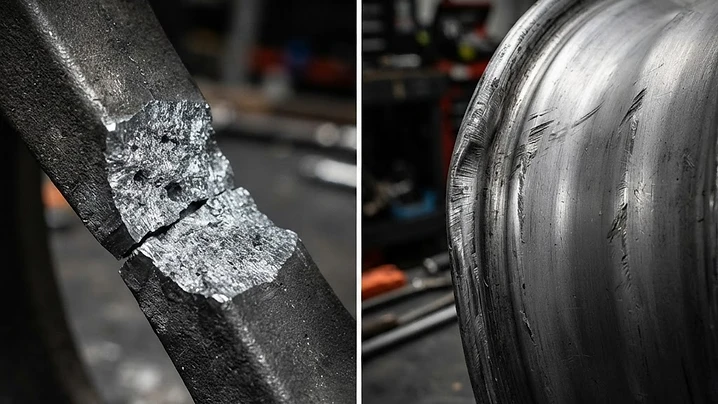
- The Failure Mode: Because the structure is non-directional, cast aluminum is relatively brittle. Under extreme stress, it doesn't like to deform; it prefers to crack or shatter.
- The Risk: A shattered wheel spoke can lead to an immediate loss of tire pressure and vehicle control.
Forged Wheels: The 'Bending' Advantage
Forged wheels begin as a solid billet of 6061-T6 aerospace-grade aluminum. This block is subjected to 8,000 to 10,000 tons of pressure, which crushes the aluminum into a dense, aligned grain structure. As noted by JC Forged Wheels, this process aligns the molecular properties of the alloy.
- The Failure Mode: Forged aluminum is significantly more ductile. Under a massive impact, a forged wheel is designed to bend rather than snap.
- The Benefit: A bent rim often holds air long enough for you to pull over safely. It is a "graceful" failure that protects the driver and the suspension components.
The Flow-Formed Compromise
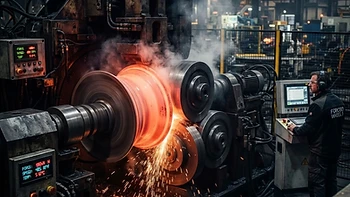
Flow forming (often marketed as "Rotary Forged" or "Hybrid Forged") is a middle-ground technology. The wheel starts as a cast blank, but the inner barrel is heated and stretched by hydraulic rollers. This process creates a forged-like grain structure in the barrel, though the face and spokes remain cast Triton Motorsports.
Buyer’s Checklist: Matching Tech to Terrain
Before you click "buy," evaluate your primary driving environment against these manufacturing truths:
- The Daily Commuter: If you live in a region with well-maintained roads, a high-quality cast wheel from a reputable brand is sufficient. Look for JWL or VIA certification to ensure the casting is free of major voids.
- The Pothole Warrior: If your commute looks like a lunar landscape, prioritize flow-formed wheels. The increased tensile strength in the barrel prevents the "flat-spotting" common in cheap cast rims.
- The Track Enthusiast: Forged is the only choice for high-lateral-load environments. Beyond the weight savings, the ability of the metal to withstand repetitive flex without fatiguing is a critical safety margin Konig Wheels.
Find wheels for your car
Pick your make and model — we'll show you every wheel that fits your bolt pattern.
Get notified when new wheels are listed
New listings drop daily. Be the first to know when wheels for your car hit the marketplace. No spam, unsubscribe anytime.