The Lever Effect: Why Wheel Offset and Hardware Choice Dictate Bearing Life
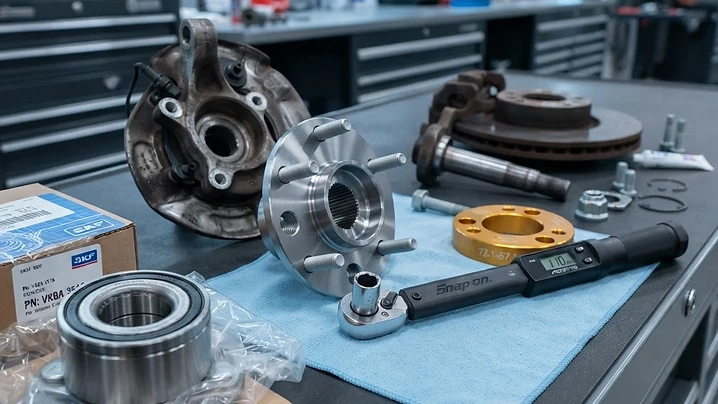
Changing your wheel offset does more than just fill out the fenders; it fundamentally alters the load physics of your hub. Learn how to diagnose bearing wear and protect your suspension hardware.
Shop accessories
Browse suspension & hardware
Shop this article
Browse suspension accessories
Crown Automotive Wheel Spacer Set (2), 5 on 5.5"
$178.5

Wheel Spacers 5x112 12mm 66.6mm Hub Centric fits Mercedes
$4.5

Original Gorilla Lock Set - Acorn Bulge - 3/4" Hex - 1/2"-20 Thread Size - Chrome Finish - Set of 5 (71481NB5)
$45

McGard 27226 Chrome Bolt Style Cone Seat Wheel Lock Set (M14 x 1.25)
$44.99
The Hidden Physics of the Flush Look\n\nWhen you decide to push your wheels out for that perfect 'flush' fitment, you aren't just changing the aesthetics of your ride. You are fundamentally altering the physics of your vehicle's hub assembly. As a shop tech, I see it all the time: a customer comes in with a beautiful set of low-offset wheels or thick spacers, complaining of a mysterious 'growl' that started just a few months after the install. The culprit is almost always the wheel bearings, and the cause is the lever effect.\n\n## How Offset Acts as a Lever\n\nYour wheel bearings are designed to support the weight of the vehicle at a specific point, known as the load line. In a factory setup, this line usually passes directly through the center of the bearing races. According to technical analysis from The Autopian, when you install wheels with a lower offset or add spacers, you move that load line outward. \n\nThink of it like holding a 20lb dumbbell. It’s easy when you hold it against your chest, but try holding it at arm's length. That extra distance creates leverage. In your suspension, this leverage forces the inner and outer bearing races to work against each other unevenly. While most bearings are engineered with a safety margin, aggressive changes can reduce a part that should last 100,000 miles down to a fraction of that lifespan. This is especially true for Electric Vehicles (EVs), which Identifix notes are significantly heavier due to battery packs, putting even more baseline stress on these components.\n\n## Diagnosing the Growl: Symptoms of Failure\n\nWheel bearing failure isn't always a sudden snap; it’s a progressive degradation. The most common symptom is a rhythmic growling, humming, or squealing that changes pitch with vehicle speed, not engine RPM. \n\n| Symptom | Potential Cause | Diagnostic Action |\n| :--- | :--- | :--- |\n| Growling/Humming | Pitted bearing races | Swerve gently; noise should change as load shifts. |\n| Steering Wheel Vibration | Excessive bearing play | Check for lateral movement with the car on a lift. |\n| Uneven Tire Wear | Alignment drift from play | Inspect for 'cupping' or inside edge wear. |\n| ABS Light | Integrated sensor failure | Scan for wheel speed sensor codes. |\n\nIf you suspect a bearing is going, the 'Swerve Test' is your best friend. While driving at a safe speed on an empty road, gently sway the car left and right. If the noise gets louder when you turn left, you are loading the right-side bearing, indicating that the right side is likely the failure point. As CarParts.com points out, drivetrain noises often change under acceleration, whereas bearing noise persists regardless of throttle position.\n\n## The Role of Supporting Hardware\n\nIf you are committed to a wide-track setup, you must compensate with high-quality hardware to mitigate the stress. \n\n1. Hub-Centric Spacers: Never use universal 'lug-centric' spacers. Hub-centric designs, often machined from T6 aircraft-grade aluminum, ensure the load is transferred through the hub lip rather than just the wheel studs. \n2. Alignment Kits & Camber Plates: Changing offset often alters your scrub radius and camber gain. Using adjustable camber/caster plates allows you to realign the geometry so the tire contact patch remains flat, preventing the 'tug-of-war' between the tire and the bearing.\n3. Upgraded Bushings: Worn rubber bushings allow for excessive deflection. Replacing them with polyurethane or spherical bearings helps maintain the alignment settings you’ve dialed in, reducing the vibration that kills wheel bearings.\n4. Torque Accuracy: This is non-negotiable. OrionMotorTech emphasizes that improper torque (too loose or too tight) is a leading cause of premature failure. Most passenger cars require between 80 and 100 lb-ft; always use a calibrated torque wrench, never an impact gun.\n\n## The 10mm Rule of Thumb\n\nThe Rule: For every 10mm you decrease your wheel offset (moving the wheel outward), expect a measurable increase in the bending moment applied to your spindle and bearings. \n\nThe Reasoning: Suspension engineers design the spindle to handle vertical loads. By moving the wheel out, you convert that vertical load into a rotational force (torque) that tries to 'peel' the bearing off the hub. If you go beyond 15-20mm from factory specs, you should move to a shortened maintenance interval, inspecting bearings every 10,000 miles instead of the standard 30,000-mile check.\n\n## What to do next\n\n* Check your current offset: Look at the back of your wheel spokes for the 'ET' stamping to see how far you've moved from stock.\n* Listen for the 'Whoom-Whoom': Turn off the radio and listen for speed-dependent humming on smooth pavement.\n* Inspect your hardware: Ensure your spacers are hub-centric and that your lug nuts are torqued to the manufacturer's specific foot-pound rating.\n* Upgrade your support: If you've gone wide, invest in an alignment kit to correct the geometry and save your tires and bearings from an early grave.
Find wheels for your car
Pick your make and model — we'll show you every wheel that fits your bolt pattern.
Get notified when new wheels are listed
New listings drop daily. Be the first to know when wheels for your car hit the marketplace. No spam, unsubscribe anytime.
Related listings
Browse suspension accessoriesCrown Automotive Wheel Spacer Set (2), 5 on 5.5"
$178.5
Wheel Spacers 5x112 12mm 66.6mm Hub Centric fits Mercedes
$4.5
Original Gorilla Lock Set - Acorn Bulge - 3/4" Hex - 1/2"-20 Thread Size - Chrome Finish - Set of 5 (71481NB5)
$45
McGard 27226 Chrome Bolt Style Cone Seat Wheel Lock Set (M14 x 1.25)
$44.99